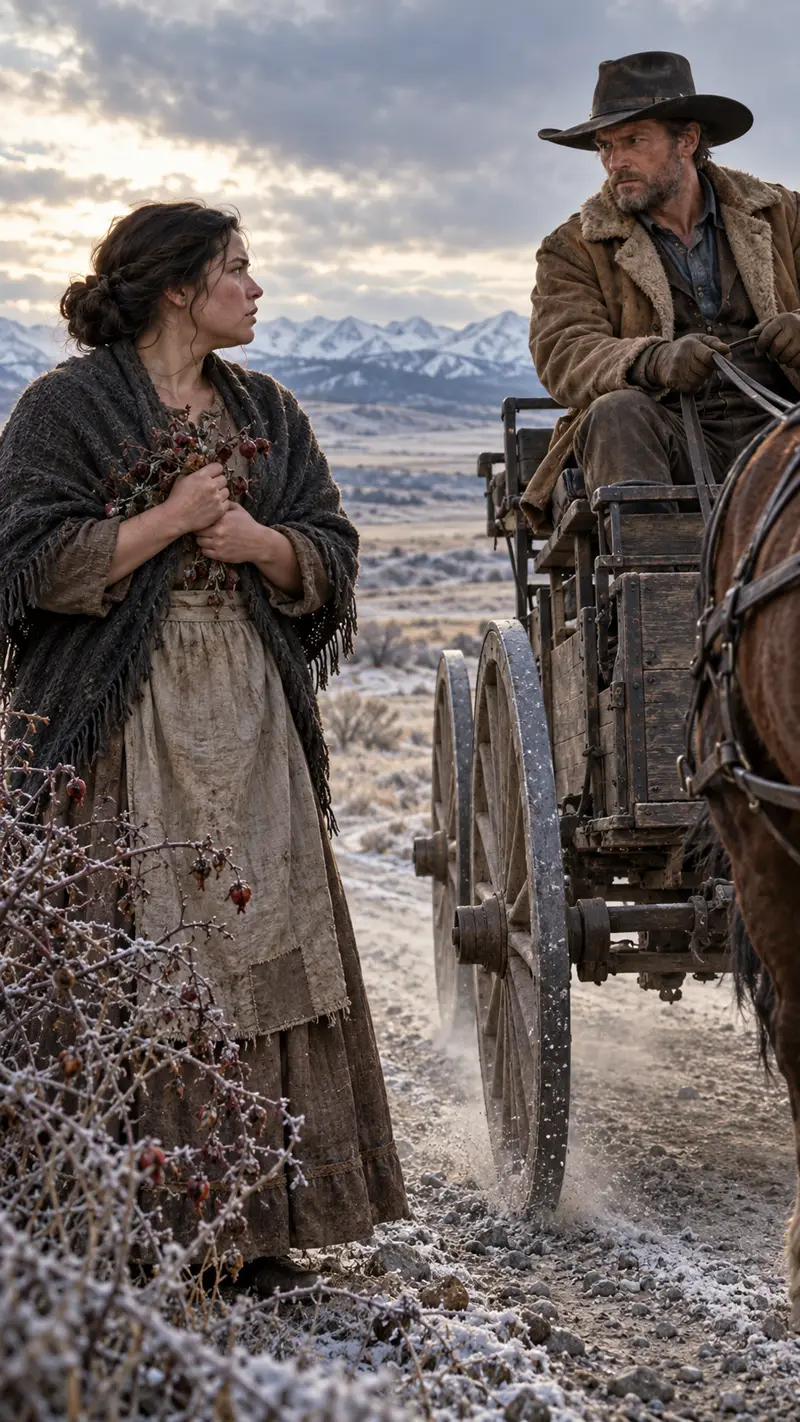
Jonah Pike traveled halfway across the territory to claim the run-down farm he had paid for with years of sweat. He never imagined that three quiet women would be waiting inside, holding the secret his mother had guarded most closely.
The weathered oak door of the prairie farmhouse swung open before Jonah could lift his calloused hand to knock.
Three strangers stood in the dim doorway. The youngest, a slight girl, held a small tarnished tin stamped with his mother’s initials.
Jonah had not laid eyes on those delicate engraved letters since the bleak morning his mother died back in Ohio.
“I believe this is yours, Mr. Pike,” said Lottie Voss, holding the tin out with steady hands.
It had taken Jonah six punishing years to afford this land. He had shoveled gravel, mended fences, and laid railroad track under a merciless sun, and all that time he had carried the deed inside his coat, dreaming of a quiet life where no stranger could make demands of him.
Now gray smoke curled from the fieldstone chimney, and the smell of fresh-baked bread drifted across the yard. Jonah tightened his grip on his bag. He would not let the warmth of that kitchen soften him.
“I paid silver for this property,” he said firmly. “The banker swore nobody had lived here for months.”
The tallest of the women stepped onto the porch with the calm authority of someone who had known hard times. “My name is Ada Wynn. We don’t mean to drive you off, Jonah, but you need to hear the bargain Orin made before he left.”
Beside her stood Irene Talbot, red-haired and watchful, her eyes taking in every speck of dust on Jonah’s boots.
Jonah set his jaw. “Orin sold me this parcel. That’s the only transaction the territory recognizes.”
At the name, Irene moved to the porch railing and cast a bitter look over the weed-choked yard. The previous tenant had vanished weeks earlier and left behind empty stalls, unpaid debts, and promises nobody could account for. Jonah had come braced for a silent ruin. Instead he had found women who kept the hearth as though it were their own.
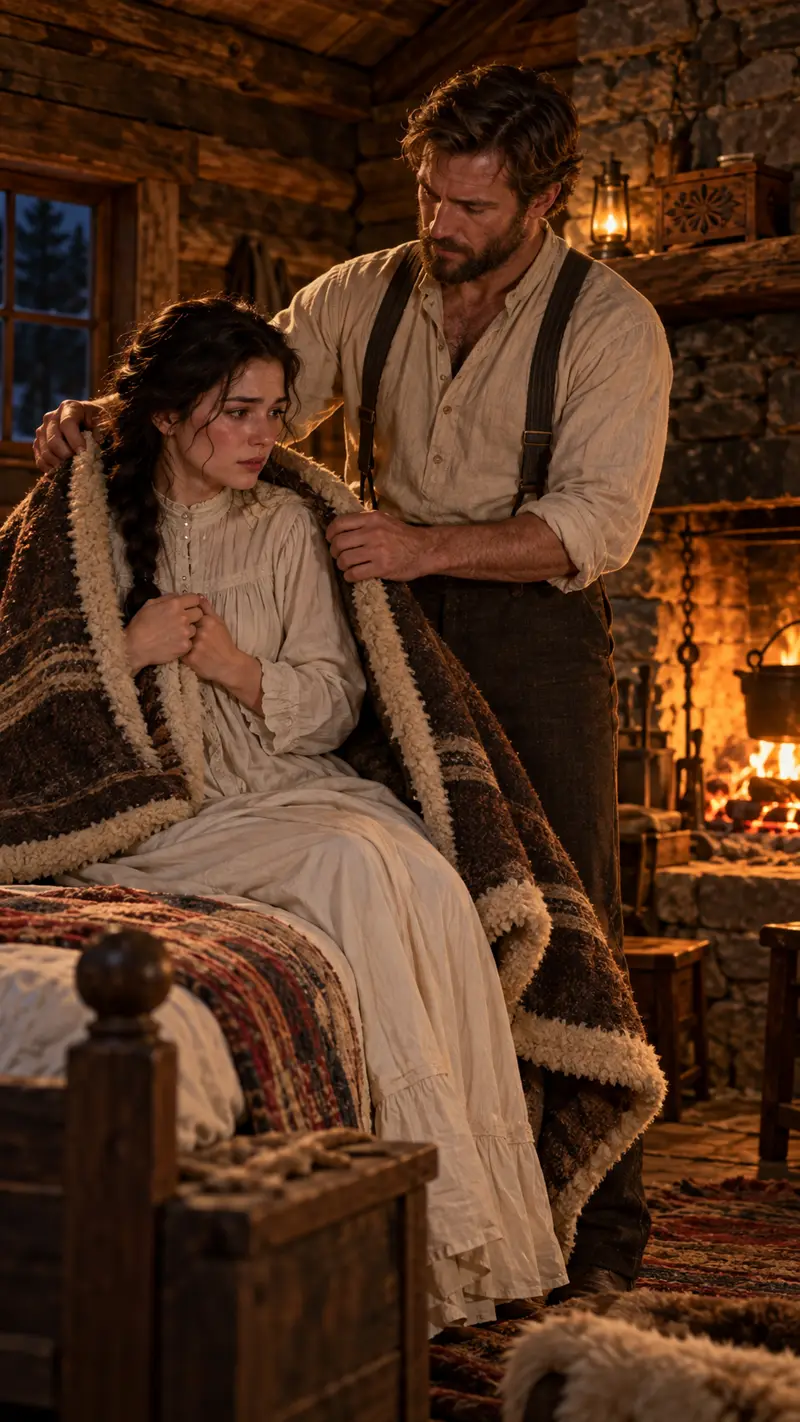
Lottie looked down at the tin cradled in her hands. “Your mother asked me to put this in your hands if you ever came.”
A chill ran through Jonah. His mother had died nearly fifteen years ago, when he was twelve. He could still smell the lavender on her apron and hear the steadiness of her voice in hard times. Most of all he remembered the two taps she always made on the table before she said something that mattered.
He stepped into the tidy parlor, his voice strained. “Where did you find that heirloom, girl?”
“Under a loose floorboard beneath the stairs,” Lottie said softly, “where Orin never thought to look. He took it for an empty box some stranger had left behind, because he couldn’t read the letters.”
Ada came to stand by the table. “We worked all spring because Orin promised this roof would be our home. We cleared the pasture and planted the garden, and then we learned he had pledged the ground to other people.”
Jonah reached out with trembling fingers and turned the little tin beneath the amber glow of the oil lamp. Scratched deep under the faded initials were two small dents, cut into the brass exactly as he remembered.
His head swam. Everything he had believed about his mother crumbled in that instant. All his life he had thought Martha Pike died penniless in a rented attic after years of sewing for rich merchants.
Irene pulled a wooden chair from the wall and offered it to him, her voice gentle even though her posture stayed guarded. “When Orin left us to face the winter alone, we had no family and no savings to carry us east. But Lottie insisted that Martha had seen this day coming. She swore her son would follow the setting sun in the end.”
Jonah shook his head, bewildered. “My mother never talked about owning a speck of Kansas dirt. Or having kin out here.”
Lottie set the tin on the pine tabletop and turned it so the two dents sat squarely in his sight. Ada unfolded a weathered document with great care, though she kept it close instead of handing it over.
“This is no worthless contract like the one Orin signed,” she said. “This was written in your mother’s own hand.”
Lottie met his eyes. “Before you read her words, you should know how our lives came to be tangled together.”
Jonah sat down slowly. The heavy deed in his pocket suddenly felt thin and light. Outside, the prairie wind rattled the windowpane, a reminder of the huge, unforgiving country beyond the sturdy log walls.
“I was an orphan working in a mill,” Lottie began, “when your mother took me in during her last years. She was failing in body, but her spirit never broke, and she talked constantly about the boy she had left behind.”
A knot rose in Jonah’s throat. For decades he had wondered why she sent him away.
“She sent you to your uncle’s farm,” Lottie said, “to keep you safe from the man who stole her inheritance.”
Jonah leaned forward. “Are you telling me Orin was kin to the woman who gave me life?”
Ada nodded. “Orin was Martha’s younger half-brother, a man who thought the world owed him an easy fortune. When your grandfather settled this territory thirty years ago, he left the valley to Martha because of her devotion. Orin burned the family register, made false claims, and drove your mother east while you were still an infant.”
Jonah listened in stunned silence. Every hard mile he had walked had led him back to the place he was born.
Before anyone could say more, the thud of galloping horses broke the stillness of the evening. Irene snuffed the lamp in a flash and plunged the room into shadow, and Ada slipped to the front window.
Two riders in heavy wool coats reined in at the foot of the porch steps, their lanterns swinging in the dusk.
“Ada Wynn!” the older one bellowed. “We know you women are hiding in that house!”
Jonah knew the voice. It belonged to Thaddeus Garrow, the wealthy land agent who had been so eager to sell him the property.
“Garrow lent money to Orin,” Ada whispered. “Now he means to push us out so he can take the bottomland.”
Jonah rose from the table and squared his shoulders, the years of railroad labor hardening his spine. He walked out onto the porch into the night air, and the boards groaned under his work boots.
Garrow squinted through the lantern light and sneered. “Pike. You’ve come early to look over your abandoned patch of dirt.”
“It isn’t abandoned, Mr. Garrow,” Jonah answered evenly. “And these women are under my roof.”
Garrow barked a harsh laugh that echoed off the barn and made his horse stamp in the dust. “Orin defaulted on a second debt of six hundred dollars, and the magistrate signed an eviction order this morning. Unless you bring me six hundred in gold tonight, the township takes every acre.”
Cold anger filled Jonah. Every last dollar of his savings had gone into the bank transfer.
Garrow tipped his hat in mock politeness. “We’ll be back at sunrise with the sheriff to clear the place.” The two men wheeled their horses and galloped off, leaving a thick cloud of prairie dust behind them.
Back in the kitchen, Irene had relit the lamp, and its light showed the dread etched on every face.
“Did the railroad pay you enough to satisfy a crooked magistrate?” Ada asked quietly.
“I have five dollars in my pocket,” Jonah admitted. “Barely enough to buy seed come spring.”
Lottie came to his side and laid a hand on his sleeve. “Then it’s time to open Martha’s tin.”
He pried off the lid. Inside lay a small key wrapped tightly in a scrap of faded ribbon.
“Your mother gave me that key when she was dying,” Lottie said, “and made me promise to find this homestead someday. She told me true justice would wait under the great fieldstone hearth until her rightful boy came home.”
Jonah’s gaze moved to the massive stone fireplace that ruled the kitchen, built of heavy river stones hauled up from the creek. Ada fetched an iron pry bar from the woodbox, and Irene knelt to sweep the loose ashes aside. Jonah wedged the bar beneath the central flat stone and leaned his weight into it until the old mortar cracked.
Underneath sat a small box of fragrant cedar, its edges sealed with pine resin. Jonah lifted it from the dry earth and felt the weight of decades of quiet sacrifice in his hands. He slid the brass key into the keyhole and turned it, and the lock clicked open with a clear, bright sound.
Inside lay an official parchment bearing the grand gold seal of the Territorial Office, untouched by damp or vermin. Jonah unfolded the thick sheet, and his breath caught at the sight of his mother’s bold signature beside the governor’s stamp.
The charter declared the land grant perpetual, shielding the property for all time from any debt taken on by secondary claimants.
The original territorial grant named Jonah Pike as the sole, irrevocable heir to six hundred acres of prime Kansas prairie.
Orin had never owned the farm at all. Every loan he took and every claim Garrow held was null and void.
Beneath the charter lay a second letter, handwritten in the slanted script Jonah had missed for half his life. He read it aloud, his voice thick.
“My dearest Jonah, if you are reading this, your hands have found their home. I had to let you go so that Orin could not destroy you the way he tried to destroy my youth. I hid this title where only someone who remembered my habit of tapping twice would think to look.”
Jonah wiped his eyes. The heavy burden of lifelong abandonment finally slipped from his heart.
Lottie pointed to the last paragraph. “Read the end, Jonah. It speaks of us.”
“A house without warmth is only timber,” Martha had written, “so whoever shelters by this hearth with an honest heart is your family. Lottie was the daughter of my quiet years, and I charge you both to protect one another against the world.”
Ada and Irene stood close together in the soft lamplight, tears in their eyes, as the threat of homelessness drained away.
Jonah looked around the kitchen at the three women who had scrubbed these floors and kept the stove burning through their loneliness. “You tended this ground when nobody else cared,” he said gently. “No crooked agent will ever put you out in the cold.”
They spent the rest of the night around the trestle table, sharing the fresh bread and talking about the struggles that had brought them here. Ada told of losing her family’s general store to a flood, leaving her no trade but a gift for organization. Irene described years in drafty boarding houses and her one dream of a quiet garden of healing herbs. Lottie recalled how Martha had taught her to read and write by the dim glow of tallow candles in that attic.
As the first streaks of dawn tinted the eastern sky, the rhythmic pounding of wagon wheels announced the sheriff. Jonah tucked the territorial charter inside his coat and stepped onto the porch to wait.
Thaddeus Garrow climbed down from his fine buggy with an arrogant smirk, flanked by Sheriff Miller and two armed deputies. “The sun is up, Pike,” he announced loudly. “By authority of the county court, this parcel goes to public auction at once.”
The sheriff came forward reluctantly, an eviction warrant in his hand and plain discomfort on his face. “I’m sorry, young man, but Orin pledged this land as collateral, and the court has to satisfy the judgment.”
“Orin couldn’t pledge what he never owned, Sheriff,” Jonah replied calmly. “This land has belonged to the Pike family since territorial settlement.”
He drew the charter from his canvas coat pocket and handed the heavy parchment straight to the startled lawman. Miller adjusted his spectacles, and his eyes widened as he studied the authentic seal and the clauses written in ink.
“This is a paramount federal land grant signed by Governor Reeder himself,” the sheriff said, fixing Garrow with sudden sharp displeasure. “It predates every municipal debt, and no county magistrate has the jurisdiction to overturn an unbroken federal patent.”
Garrow turned crimson. “That has to be an old forgery! Orin showed me valid county tax stubs!”
Ada stepped up to the porch railing and held up a ledger. “Orin stole those papers from the archives. We found this in the loft, with his signed confessions about his dealings with Mr. Garrow.”
Miller took the ledger from her hand, and his weathered face set in the stern look of frontier justice. “Mr. Garrow, I suggest you climb back into that buggy before I take a look at your books at the courthouse.”
Without another word, the disgraced agent scrambled into his rig and whipped his team away in a cloud of dust. The sheriff tipped his hat to Jonah and the women, apologized for the trouble, and led his deputies back toward town.
Silence returned to the golden prairie, but it was no longer the heavy silence of dread. On the porch, the three women stood together with faces full of relief and quiet joy. Irene let out a breathless laugh, and Ada rested a steadying hand on Lottie’s shoulder as the morning sun warmed the timbers.
Jonah took the little brass tin from his pocket and looked at Lottie with deep understanding. She smiled through her tears, knowing she had finally kept the sacred promise she made to Martha on her deathbed.
“This farm will need every one of us,” Jonah said, “to plant the corn, mend the barns, and rebuild what was left to rot.”
“We’ve never been afraid of hard work,” Ada answered with a warm smile. “Only of having no ground to call home.”
They went back into the bright kitchen together, where the fire burned steady in the hearth that had guarded their future. Jonah pulled out his mother’s old wooden chair and sat at the head of the scrubbed pine table, his heart at peace. He raised his hand and tapped twice on the polished wood. The sound drifted through the room like an answered prayer.
Lottie glanced up from slicing the warm loaf, and her face shone with peace and belonging.
The wandering years of railroad dust and lonely bunkhouses were behind him. Under the wide Kansas sky, the neglected farm had at last become the haven of kindness and quiet strength that Martha had always pictured.