The whole valley had looked at a widow and seen nothing but need. Only she noticed the numbers hiding in plain sight, and once she opened the ranch books under the winter lamplight, two lives were rewritten.
A tin lantern's yellow glow pushed back the freezing dark of the pantry and landed on a man caught stock-still between the wooden flour bins.
It was Garrett, who had managed Silas Vance's livestock as foreman for eight years. His hand hung in the air above the cedar shelf.
“Looking for something?” she asked softly. She held the heavy lantern steady against the draft creeping up through the pine floorboards.
The tall man jerked his gloved hand back as if the shelf had burned him. His weathered jaw hardened into a defensive sneer.
“Checking the salt stores before tomorrow's snowstorm,” Garrett muttered, irritation flaring.
“The salt's been by the smokehouse door since late September,” Eliza said. She did not so much as flinch under her dark woolen shawl.
She knew exactly what he was after. Three hours earlier, before the bunkhouse stove went cold, she had moved the heavy earthenware crock herself. Down inside it, under a layer of dry cornmeal, lay forty-six carbon copies of freight weigh-bills from the Helena depot. The crumpled tissue slips told a quiet story of eight hundred steers supposedly lost to mountain fever during summer grazing. Every one bore the private seal of Julian Sterling, the wealthy timber baron who owned every square mile around Vance land.
“You've got some nerve, creeping around this house after midnight,” Garrett hissed, stepping close enough to loom over her.
Eliza held her ground. She had lived through colder winters and met crueler men than the one now sweating in her kitchen.
“I live under this roof by honest work and a clean conscience,” she said, and her voice rang off the scrubbed pots.
Before Garrett could answer, heavy bootsteps sounded in the hall, and Silas Vance's broad silhouette filled the narrow doorway. His gray eyes moved from his trusted foreman to the widow he had brought home, dark with confusion.
“What is going on in my kitchen at this hour?” His voice broke the silence like a plank snapping.
Garrett smoothed his canvas coat at once and pointed a leather glove at the apron tied around Eliza's waist.
“Caught your new cook snooping in the pantry. Stashing provisions to sell in town, I'd wager,” he said, smooth as butter.
Eliza neither raised her voice nor showed a trace of panic. Long ago she had learned that truth needs no theatrics. She set the iron lantern on the table and met Silas's eyes with unyielding dignity.
“If Mr. Vance will give me five minutes at his desk, I'll gladly show him what was really hidden here.”
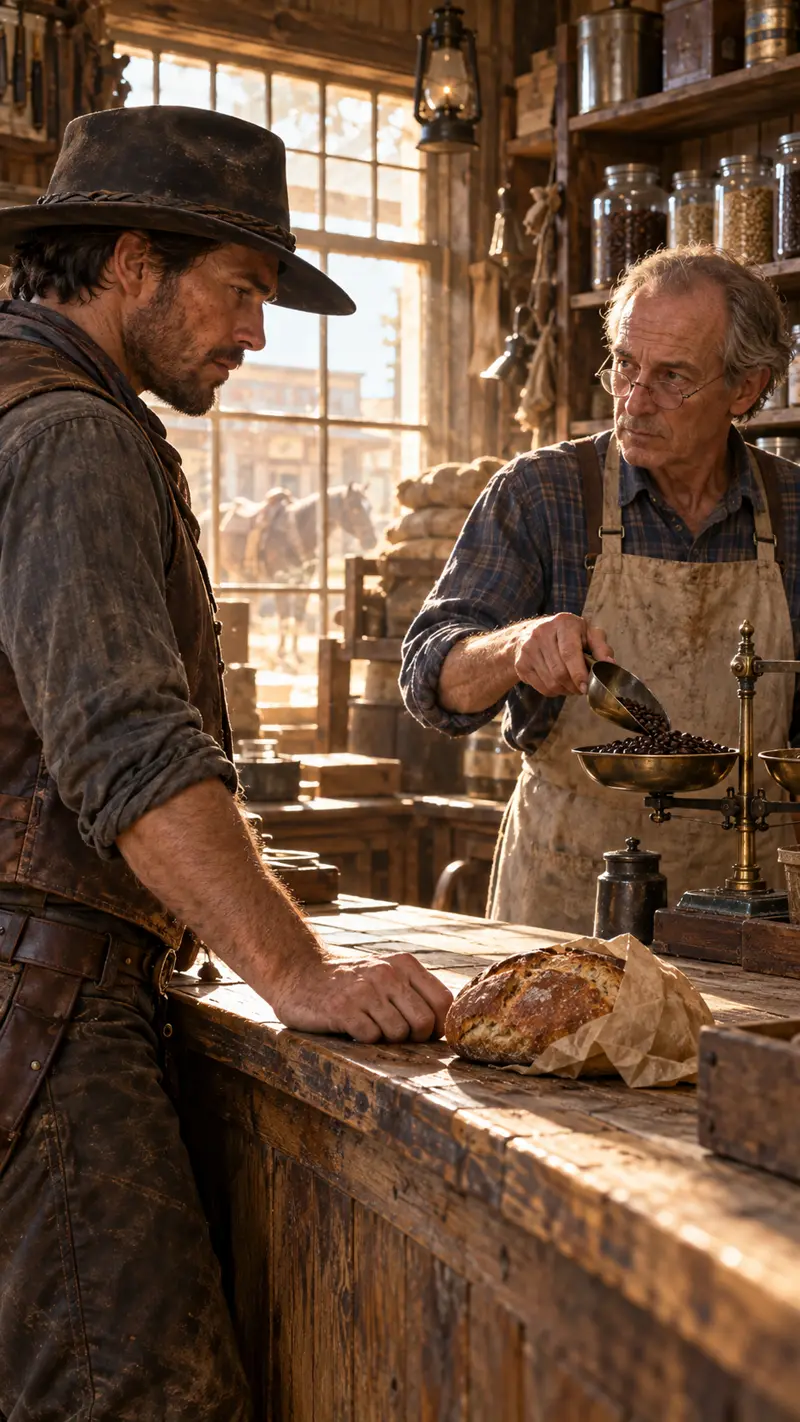
Silas studied her steady face and remembered the October morning he had first found her picking berries outside Cedar Creek. In that dusty settlement the townsfolk had treated Eliza Merritt as a castoff, a burden weighed down by her late husband's debts. The mercantile clerk had laughed so cruelly at her poverty that he spilled hot coffee across his own polished counter. All anyone saw was a poor widow in patched skirts, and they took her quiet manner for simple foolishness.
They never knew that for fifteen years of her youth she had been head clerk in her father's railway office. Her mind could work out shipping tariffs and livestock weights faster than most territorial bankers could write them down. When Silas stopped his wagon and offered her wages to feed eleven worn-out hands, she accepted to keep her dignity.
What she found in the Vance ranch house was a homestead crumbling under exhaustion, bitter despair and cold hearths. Eleven ranch hands had been driving themselves across the range on scorched beans, hard biscuits and rancid salt pork. Silas worked sixteen hours a day until his hands cracked, desperate to keep the bank from seizing the land.
Within a week Eliza had turned the drafty bunkhouse into a place of warmth, order and hearty meals. Golden loaves of sourdough cooled on scrubbed planks, and venison stew simmered all day over glowing hickory coals. The men sat up straight at the harvest table again. Their laughter returned as their hollow cheeks filled out. Silas often found himself lingering by the hearth just to hear her sing, and for the first time since his father was buried he believed the ranch might outlast a Montana winter.
But while Eliza kneaded the morning dough and stirred the porridge, her sharp eyes tallied every pound of grain that came into the storehouse. The numbers refused to balance, and the quiet arithmetic kept her awake while the rest of the ranch slept. Silas paid invoices for three hundred sacks of milled grain every month, yet the shelves held barely ninety sacks of feed. The ledgers recorded fifty barrels of winter salt pork bought with coin, and only twelve sat in the cellar. Worse, the autumn tallies blamed wolves for eighty prime heifers, though no carcass had ever turned up on the ridges.
Eliza had come to a chilling certainty: Silas Vance was not the victim of bad luck but of a deliberate robbery from the inside.
Now, deep in the winter night, the three of them stood in the drafty parlor around Silas's scarred oak desk. Outside, the Montana wind howled over frozen meadows and rattled the frost-crusted window glass. Silas trimmed the wick of the brass lamp and looked down at the neat receipts Eliza had laid across the blotter.
“Garrett's been my foreman since we turned the first sod on that pasture,” Silas said, hunting for a reasonable answer.
“He has also drawn a second salary from the territorial land office in Helena,” Eliza replied, setting three stamped envelopes in front of him.
Garrett lunged for the papers, but Silas's heavy hand came down on the desktop like a falling timber.
“Keep your hands off, Garrett, until I've heard what she has to say,” Silas growled, low and dangerous.
Eliza opened the little black notebook she carried, its pages full of her precise handwriting and tidy sums.
“On November twelfth, your books say twenty prime steers died in the freeze near Willow Creek,” she said, running a finger down the column. “Yet here is the official rail receipt showing twenty Vance cattle loaded onto freight cars for Chicago that same night. The six hundred dollars wasn't deposited to your account, Silas. It went into an escrow fund held by Sterling's bank.”
The color drained from Garrett's weathered face as the cold lamplight laid the truth bare on the crisp paper.
“It's a ridiculous lie, cooked up by a penniless beggar hoping to curry favor,” he spat through his teeth.
“Then explain why your signature sits beside Julian Sterling's notary seal on every manifest,” Eliza answered, perfectly composed.
Silas lifted the yellowed manifest. His calloused fingers trembled as he recognized the handwriting of his closest friend. For eight years he had broken bread with Garrett, trusted him with the herds and given him a share of the profits.
“Why would you do this to me, Garrett?” The sorrow in his voice was heavier than snow.
Garrett dropped every pretense of loyalty, sneering now that the paper trap had snapped shut around him.
“Because this valley belongs to men of capital, Silas, not stubborn dreamers breaking their backs over rocks. Sterling's putting a railway spur through this basin, and your water rights are all that stand between him and the county. Tomorrow noon the mortgage note you signed with the Helena bank falls due, and you've got nothing to pay it. Sterling already bought that note. With the court behind him, he'll take the whole ranch.”
Silas sank slowly into his high-backed armchair as the weight of foreclosure settled on his broad shoulders like lead. It was true. The four-thousand-dollar payment came due before the courthouse clock struck twelve tomorrow. With eighty cattle gone and the feed bins empty, he had less than two hundred dollars in silver in his safe.
“I've got nothing left to give them,” he whispered hoarsely, staring up at his father's portrait above the stone fireplace.
“You have far more than you know, Silas,” Eliza said, and her warm, steady voice cut through the heavy gloom. “Julian Sterling doesn't own this valley, and by tomorrow morning his own stolen paper will be his undoing.”
For the rest of that freezing night, while Garrett sat under guard in the bunkhouse, Eliza and Silas worked beside the hearth. Page by page she showed how Sterling had steadily siphoned three years of grain deliveries and livestock sales into private companies. She rebuilt the true accounts and proved that Sterling had pocketed more than nine thousand dollars from cattle wearing Silas's brand.
“Under the territorial commerce statutes, a creditor who secretly liquidates a debtor's collateral forfeits every legal claim to the mortgage,” she said.
Silas looked up from the glowing coals, and what he felt was admiration, far deeper than thanks for his saved acres. Here was a woman cast off and mocked by small minds, yet as enduring as a mountain cedar.
“How does someone like you end up starving at the edge of town, Eliza?” he asked softly, touching her woolen sleeve.
“My late husband was a gambler who promised fortunes and left tavern debts and angry creditors,” she said quietly. “When the law took our little house, the town decided his failures were mine and shut every door on me. They forgot that a person is measured by the honesty of her labor and the clarity of her conscience.”
Silas smiled with real warmth and laid his calloused hand over her flour-dusted fingers on the open ledger.
“No one will shut a door on you in this valley again, Eliza, not while I'm alive,” he promised.
Beyond the frosted windows the sky was shifting from inky black to the pale, icy lavender of winter dawn. The decisive hour had come. Carriage runners crunched on hard snow, and Julian Sterling had arrived.
A polished black cutter sleigh behind two handsome bay horses pulled up at the porch, kicking up plumes of powder. Sterling climbed out onto the packed snow in a beaver coat, a gold chain glinting on his waistcoat. Beside him walked Sheriff Caleb Stone, carrying the foreclosure writ stamped with the red territorial wax seal. The eleven ranch hands had gathered quietly around the porch steps, their breath rising like gray smoke.
“Good morning, Silas,” Sterling called with an easy, practiced smile that never reached his cold, calculating eyes. “Have you got the four thousand dollars to satisfy your mortgage note, or shall the sheriff start posting notices?”
Silas walked out onto the porch with his head high and his hands calm at his sides.
“I don't have four thousand dollars in paper currency, Sterling,” he said, his voice carrying across the yard.
Sterling chuckled and turned to the sheriff, sweeping an arm toward the sprawling pastures of pine and frozen grass.
“Then the law has settled it. I'll take possession of the house, the barns and the water rights at once.”
“Nothing is settled, Mr. Sterling,” said a clear, musical voice from the open doorway behind Silas.
Eliza stepped into the morning sun with a thick folder of bound ledger pages and verified railway shipping receipts. Sterling scoffed at her plain frontier dress and woolen shawl with the dismissive arrogance of a rich, powerful man.
“I didn't realize Silas Vance let his kitchen help meddle in serious territorial legal matters,” the baron sneered.
“This woman is the chief financial accountant of Vance Ranch, Sterling, and you will speak to her with respect,” Silas said.
Eliza walked calmly to the railing and placed the bound documents in the leather-gloved hands of Sheriff Stone.
“Sheriff, if you turn to page four you'll find the Helena rail manifests for eight hundred cattle bearing the Vance brand. Over eighteen months they were diverted through private sales that Julian Sterling and the former foreman, Garrett, arranged in secret. The value realized exceeds nine thousand four hundred dollars, every cent of it deposited into Mr. Sterling's personal accounts.”
Sheriff Stone pushed his spectacles up his nose and frowned deeply over the stamped railway receipts.
“These are certified depot records from the territorial capital,” he murmured, then looked sharply at the wealthy landowner.
“Utter nonsense! Forgeries from a desperate bankrupt!” Sterling shouted, his face reddening.
“The depot master in Helena confirmed the duplicate manifests by telegraph two hours ago,” Eliza said evenly. “By law, Mr. Sterling, the mortgage was paid in full eight months ago, and you now owe Vance Ranch five thousand four hundred dollars.”
A stunned murmur ran through the ranch hands, who looked from the shaking baron to the quiet woman on the porch.
Sheriff Stone shut the leather folder with a snap and turned squarely to face Sterling.
“Julian, this writ is void, and you're coming with me to the county seat to answer for fraud.”
Two deputies stepped out of the tree line and walked a pale Garrett and the sputtering baron to the waiting sleigh. As the black sleigh vanished down the snowy road toward Cedar Creek, a roar of cheering went up from the eleven ranch hands. Men who had spent months dreading the loss of their home and livelihood flung their wool hats into the sky. They no longer saw a poor widow who cooked their meals. They saw the brilliant mind that had saved them.
Late that afternoon, once the excitement had settled and the bunkhouse stove crackled with dry pine, Silas came into the kitchen. Eliza stood at the frosted window, watching golden winter light spill over the snowy ridges of the Montana wilderness.
“The whole county's talking about what you did today,” he said gently, stepping up beside her at the cedar sill. “That shopkeeper who laughed at you came by with dried fruit and apologized for his cruelty.”
Eliza smiled faintly and shook her head as a magnificent red-tailed hawk circled over the distant pines.
“People judge by the surface when their hearts are too hurried to look for the truth,” she said, without bitterness.
Silas drew a fresh sheet of heavy parchment from his coat pocket and laid it on the table. It was a new deed of ownership, drawn up with the territorial registrar, naming the two of them equal partners.
“I can't run this place without your mind, Eliza, and I don't want to face another winter alone,” he admitted.
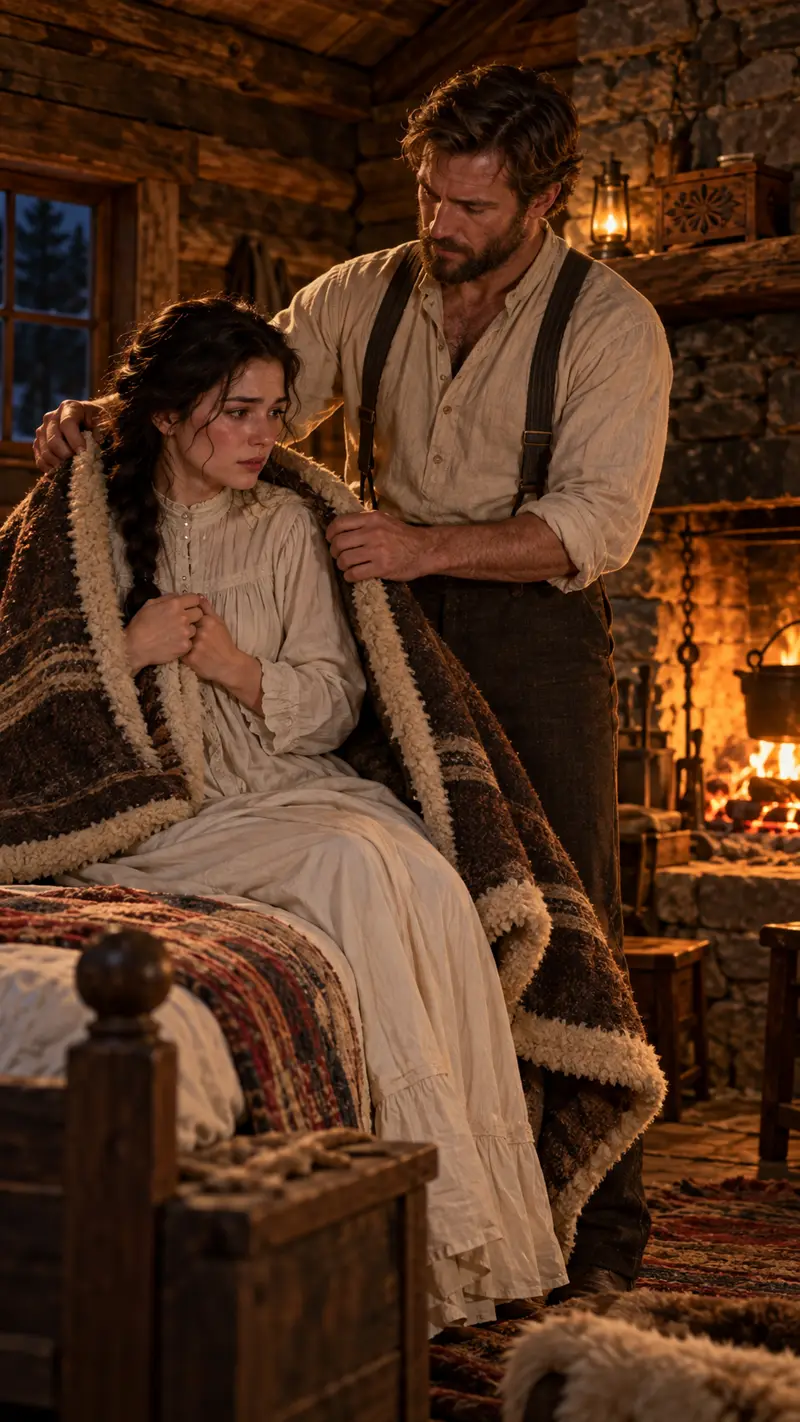
She turned to him, her heart swelling with a feeling she had thought buried for good under the hard trials of her past. His warm gray eyes held no pity and no condescension, only the deep devotion of a man who honored her worth.
“I would be proud to build this future beside you, Silas,” she said softly, her voice full of peace and gratitude.
Evening shadows stretched across the quiet Montana valley, and the kitchen filled with the warm scent of fresh bread cooling on the sill.