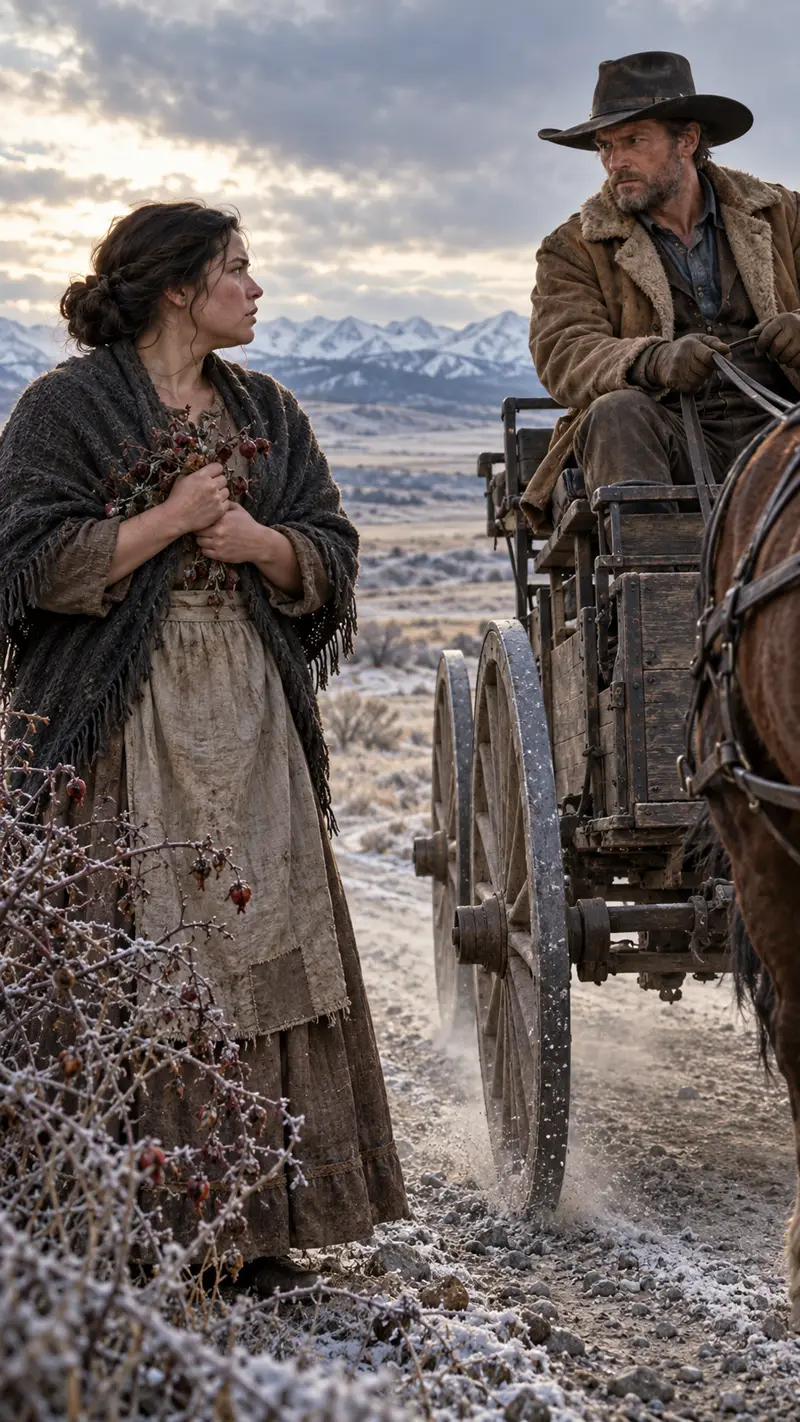
Amos Tolland stood in his cabin doorway, one hand wrapped around the smooth pine frame, while the first amber light of morning slid across the valley floor. What he saw made him forget to breathe.
Dozens of Apache horsemen sat motionless along the northern ridge, black shapes cut out of the pale sky. More waited on the eastern crest, where the wind combed the grass. A third silent line held the dry streambed to the west. In all his years on this territory homestead, Amos had never seen three hundred horses gathered in one place without a single war cry to break the dawn.
Behind the house, his two plow mares stamped against the corral fence. They could feel the strange hush lying over the cedar flats. Amos kept his weathered hands where everyone could see them and stepped away from the door, where his old lever rifle leaned unused against the wall. He knew no set of cabin walls could hold against such numbers if the riders had come to fight.
But no bow was drawn. No iron barrel lifted. Not one war pony was spurred toward the open basin.
From the middle of the northern line a lone gray stallion started down through the red boulders, picking its footing with care. The rider was an elder with a creased face and the calm authority of a man who had led his people through many hard seasons. He wore a faded calico shirt under an elk hide vest, and his long silver hair was tied neatly behind his shoulders. Thirty feet from the porch steps he halted and raised his open right palm to the sky. Then he lowered it and pointed at the stone well in the yard.
On the eastern slope the mounted ranks parted without a word, leaving a wide lane between the rows of painted ponies. Down that lane walked the tall Apache woman Amos had sheltered beside his fence the afternoon before. The trail dust was gone from her face. Her dark hair hung in two braids bound with leather. She wore a fresh tunic of white mountain sheepskin, and three strands of polished blue turquoise lay against her throat. As she passed, every rider along the slopes bowed his head a little, the way people do before someone sacred.
She went straight to the well. Her dark eyes found Amos's, with the same unbending strength he remembered.
The old leader swung down from his saddle with surprising ease and planted his moccasins in the dusty yard.
"You are Amos Tolland," he said in careful English. His deep voice carried easily over the hushed valley.
Amos nodded once and tried to keep his shaking fingers from showing how awed he was. "I am," he said, quietly and respectfully, under the stare of hundreds of watching eyes.
The elder rested a weathered hand on the woman's shoulder and looked at her with a father's deep tenderness. "This is Tazhi, daughter of our council and keeper of our sacred songs. Yesterday she was dying in the salt basin. One cup of your spring water saved our people from ruin."
The memory swept through Amos like the gust that runs ahead of a summer thunderstorm.
It had been over a hundred degrees when he first noticed a figure leaning against the timber post. Her lips were dry as salt, and her knees were giving way as she fought to stay on her feet in the dust. She carried no water pouch, no pack, no weapon, out in that merciless country of gravel and sagebrush. Plenty of ranchers on this frontier would have shouted an alarm or grabbed a rifle at the sight of a stranger like her. Amos saw only another human being near the end of her strength under a brutal sun.
He had walked straight to the wooden bucket in the shade of the cottonwood without asking who she was. He filled the deep iron ladle with clean, cold water drawn from thirty feet below the limestone of his pasture. When he held it out, brimming, she hesitated and searched his face for any hint of a trick. She found only honest sorrow and quiet respect in his pale eyes, and she took the heavy ladle in both trembling hands. She drank exactly three measured mouthfuls, savoring the coolness and setting the ladle down with a dignity that thirst could not shake. Then she stood perfectly straight and studied him in silence, every line in his forehead and every silver thread in his beard. Without a word she turned toward the northern foothills and disappeared into the shimmering heat.
That evening Amos had gone back to his chores and told himself it was only one more shadow passing through his life. He had lived alone on the creek claim for six years, since fever took his wife Sarah. Some nights the four rooms felt as big as the territory itself, and his horses were his only company. At twenty minutes before eight, before he turned down the kerosene lantern, he had opened the leather ledger on his oak kitchen table and written the plain truth of his day in steady ink. *"An Apache woman at the well, in need of water, gone north."* He had closed the book and snuffed the wick, sure that the desert had swallowed both the traveler and his small kindness.
But near midnight a restless noise had pulled him out of his blankets and into the cold. In the barn behind the house his sorrel gelding was stamping against the cedar planks of its stall and snorting at the shadows along the northern wash. The bell mare whinnied sharply toward the dark ridges with her ears pinned flat, as if she heard muffled hooves crossing stone. Amos had stood by the corral gate with his lantern dark and heard nothing but wind sighing in the pines. He had decided wolves had spooked the herd. He never guessed that a whole people was gathering in the dark.
Now, in the morning light, he understood. Every breath of that night wind had carried the footsteps of three hundred protectors. They had crossed thirty miles of black volcanic rock, and they had come to surround a treasured daughter with their devotion, not to bring harm.
Chief Delshay stepped up to the well and laid his hand on the cold masonry Amos had built himself.
"Four suns ago, men from the valley town ambushed our delegation as we carried treaty belts to the fort," the chief said. "They scattered our horses into the dry washes. They drove Tazhi out into the trackless alkali desert, where no mountain creek runs. They meant for the summer sun to silence her before she could tell the governor's commissioners who had stolen our valley meadows. For two days she walked through the furnace of the white flats with the sacred peace documents hidden under her deerskin tunic. When she reached your fence her tongue was swollen and her strength was gone. She was ready to fall into the long sleep."
His voice dropped lower. "In the mountains our young men gathered three hundred war ponies. They believed the settlers of this valley had ended her life. We rode south in the dark with anger burning in our hearts, ready to sweep through every homestead along the river bottom."
"Then my daughter reached our mountain camp at midnight and spoke your name before the council fire."
Tazhi lifted her chin. Her clear, melodic English sounded like cold water running over smooth river stones. "I told my father that the farmer alone on this land did not insult my people and did not ask a price for his water. I told them an honorable man lived on this soil, and where honor lives, peace must be offered back."
Silence settled over the yard. Amos felt the weight of how near it had all come to ending, and his spirit shook.
Before he could find any words of thanks, hooves clattered hard from the narrow southern gap behind the bluff. A thick column of yellow dust climbed into the morning sky, and a dozen mounted white men spurred into view. At their head rode Silas Vance, the wealthiest land speculator in the territory, with several hired drovers and a county deputy at his flanks.
Vance hauled his black stallion to a stop at the edge of the yard. His florid face went pale at the cheekbones. Three hundred Apache riders sat above him without so much as shifting, and their stone-faced quiet was far more frightening than shouting. His hand came down heavily on the handle of his holstered sidearm, but he did not dare lift it an inch.
"Tolland, step away from those people this instant!" he barked, straining to sound big. "We tracked a runaway native woman across your southern boundary. By territorial law she's wanted for trespassing on my range!"
Behind him the young deputy fidgeted with his tin badge and stared up at the hundreds of motionless horsemen with wide, nervous eyes.
Amos took three deliberate steps and put himself squarely between Vance's posse and the woman by the well. "There'll be no shouting on my land, Silas," he said. His calm firmness startled the riders. "The only trespassing in this valley was done by your drovers, when they drove an innocent woman into the desert to die."
Vance's eyes narrowed with venom as he saw his cowardly scheme coming apart in the bright morning. "You've got no proof of that slander!" he shouted. "Harboring fugitives on an unpatented homestead will cost you this claim for good!"
Amos turned his back on him and went into the cabin. He came out seconds later with the black leather ledger in his hand. He walked up to the deputy's skittish horse and held the open pages in front of the young man's startled face.
"Read the record, Deputy Miller," he said quietly, tapping the crisp black ink with his thumb. "Yesterday at twenty minutes before eight, I wrote down that this woman came to my fence alone, carrying no stolen property at all. She drank three swallows of water from my well and walked peacefully into the foothills, toward the boundaries the treaty set for the reservation."
Tazhi reached into the folds of her deerskin tunic and drew out a cylinder of heavy parchment tied with a blue ribbon. She held it high so every man in the yard could see the unbroken red wax crest of the territory's seal. "These are the true land deeds signed by the governor in Santa Fe," she called across the silent valley. "They prove the southern meadows belong to our people, and that Silas Vance forged the papers he used to take them."
Deputy Miller looked from the seal to the ledger, and his jaw tightened with a new resolve. He turned his horse away from the arrogant rancher. "Take your hand off your belt, Silas. You lied to the sheriff's office about theft, and you'll answer to the circuit judge when court convenes on Friday."
Vance glared at the lone homesteader who had stood against him, but the utter stillness of the ridges drained his nerve. Without another word the disgraced speculator wheeled his mount and galloped for the southern road, his hired men trailing behind. Miller touched his hat brim to Amos and the Apache elder, then spurred after the retreating posse.
The hoofbeats faded. A long breath seemed to pass through the valley like morning wind. Amos let the ledger sink to his side, and his shoulders dropped as the terrible tension melted off the homestead.
Chief Delshay smiled for the first time, and the deep lines around his eyes softened into lasting gratitude. "You stood against men of your own kind to protect the truth for a stranger who had no claim on you," he murmured. "A man who defends the truth with a ledger and a ladle of water is stronger than any army of iron."
Tazhi came forward until she stood right in front of Amos. The tenderness in her gaze made his eyes sting. She opened the small beaded pouch at her waist and took out something that stopped his breath in his throat.
In the palm of her slender hand lay a small round medallion carved from old juniper and set with pale blue turquoise. The wood had darkened to a rich chestnut over the decades. On its back was cut a simple letter *T* twined with lilies.
Amos stared at the little carving, and his heart pounded as an impossible memory from boyhood rushed up through him.
"Where did you find this?" he whispered. His voice shook so badly he could hardly shape the question.
Chief Delshay laid his weathered palm over his daughter's hand, and his dark eyes shone with memories forty years deep. "In the terrible winter of the great sickness, forty summers ago, a white family traveling by covered wagon was trapped in the pass. The father had died of the cold. The young mother had two handfuls of flour left to feed her little son. My late mother found them shivering in the wagon box. For weeks she brought them warm broth and dry cedar wood every day. Before the snow melted and the wagon could roll on, the grateful mother sat by the fire and carved two matching juniper medallions. She kept one for her boy. The other she hung around my mother's neck, as a promise of peace that would never end."
Amos reached into the collar of his rough homespun shirt and pulled out a thin leather cord he had worn since he was a boy. Hanging from the worn thong was the exact twin of Tazhi's medallion, with the same carved *T* and mountain lilies. For forty years he had kept it in memory of his mother, Martha Tolland, who had taught him that kindness mattered most. Yesterday Tazhi had seen its match on the windowsill beside his water bucket, and she had known at once whose roof she had reached.
"The water you gave my daughter yesterday was not the beginning of our friendship," Chief Delshay said gently, while tears filled Amos's eyes. "It was the continuation of an unbroken circle that your mother's loving hands began before this ranch was ever built."
Tazhi set her medallion in Amos's open palm and folded his rough fingers around the smooth wood that joined their two families. "When you look toward the northern mountains," she said gracefully, "know that our people will remember the spring that flows with honor."
Delshay raised his hand to the sky one more time. The three hundred riders on the bluffs, silent until now, turned their mounts as one toward the blue wilderness of the peaks. No dust billowed behind them as they left. They moved like a summer cloud drifting over the sky. A rider led up a gentle pinto mare for Tazhi, and she mounted and looked back once to give Amos a smile he would never forget.
Within minutes the long ridgelines that had looked so menacing at sunrise stood empty again under the warm sun. Amos stood alone by his stone well and listened to mourning doves cooing in the cottonwood. His mares grazed along the clover at the pasture fence, no longer afraid of shadows on the slopes. He looked down at the two juniper medallions lying side by side in his hand and felt a deep warmth take the place of his loneliness.
Out here on the frontier, he thought, fences might cut up the land, but a single ladle of water could join two worlds for good.