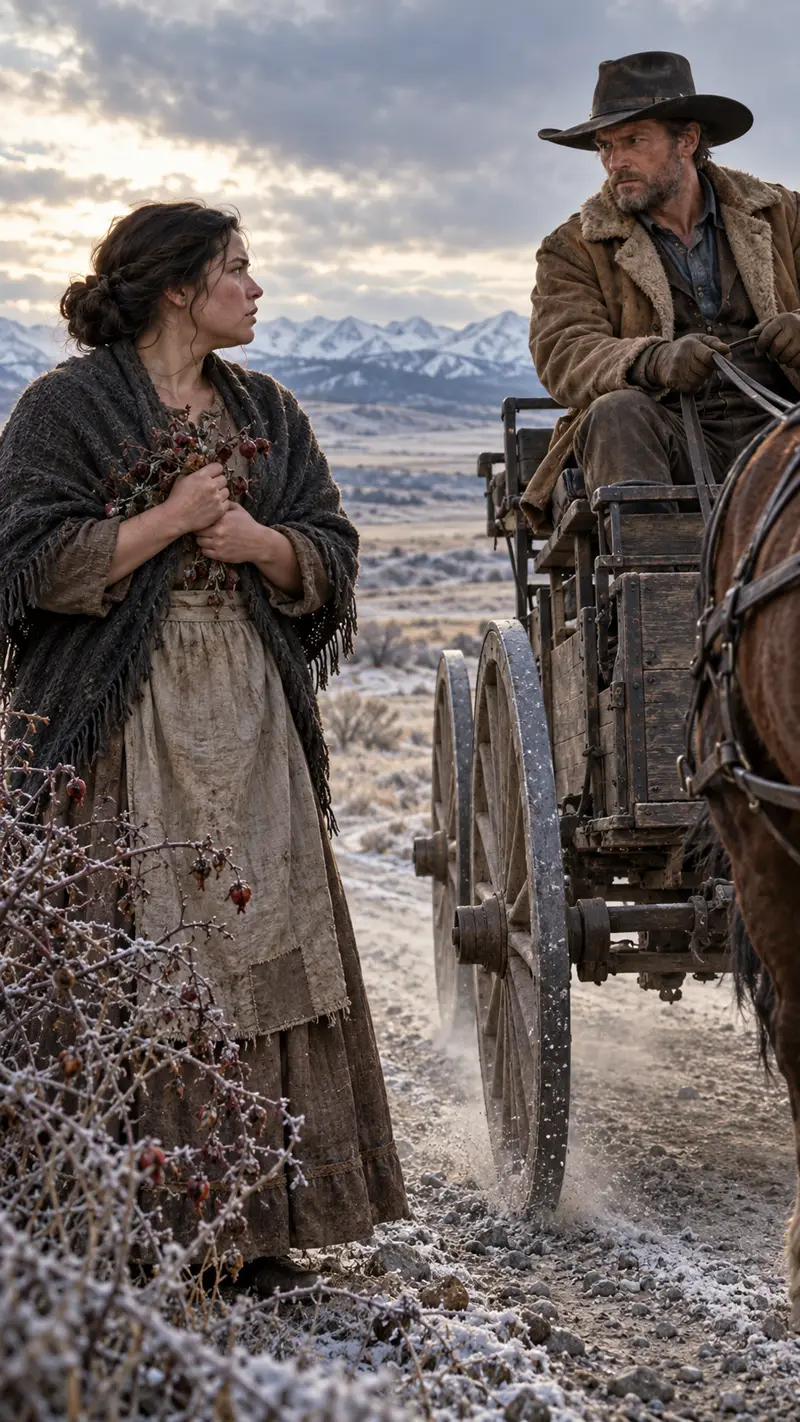
He thought he had arranged a quiet marriage of convenience with an ordinary stranger from St. Louis. She showed him that a woman running from hardship could carry more courage than the mountain itself.
The morning passenger train shuddered on its frozen rails and ground to a stop at the snowbound Silver Plume depot. Harlan Beckett stood motionless under the platform roof, pulling his sheepskin coat tight against the piercing Colorado wind.
At thirty-five, he had come through twelve brutal winters with nothing but his timber axe and his own two hands. He had not written to the marriage agency looking for love. He wanted a practical woman willing to share the work of his homestead. His letter had promised plain food, warm shelter, and honest protection in return for a wife who understood the frontier. The short notes that came back from Missouri described an industrious widow used to hard physical work and quiet endurance.
But when the passenger car door swung open in a cloud of steam, the woman who stepped down looked startlingly fragile against the snow. Dark hair framed her pale face, and her slender fingers shook on the handle of a battered leather case. Harlan crossed the frost-crusted planks of the platform until her startled gray eyes rose to his weathered face.
"Are you Miriam Whitcomb," he asked bluntly, "the widow who answered my notice through the agency?"
She drew a shallow breath of freezing air. "I am. And you must be Mister Beckett."
He looked down at her slight frame and felt a sudden twinge of regret for the long railway fare he had paid. "Your letters gave me the wrong idea," he said, shaking his head. "You don't look ready for this altitude. The next train east leaves tomorrow morning. I'll pay for your room tonight and send you home."
For one silent second the shivering stranger went rigid. Then her chin lifted with a fierce dignity that caught the woodsman off guard. "I'm not going back east," Miriam said evenly. "An agreement doesn't dissolve because the weather turns harsh. We signed our names, and Reverend Talbot is waiting for us at the chapel."
Harlan frowned at her resolve. "The high timber country shows no mercy. Winter won't bend to pride."
She looked straight into his eyes. "I have endured trials far colder than any winter wind, Mister Beckett," she said, almost in a whisper.
Her quiet conviction bothered him. Still, he had spent his life keeping his word once it left his mouth. He took her scuffed case without another word and led her through the swirling snow along the settlement's boardwalks.
Inside the dim wooden church, tallow candles flickered against the timber walls while the gale rattled the windowpanes. Reverend Talbot peered over his spectacles at the pair, taking in the contrast between Harlan's rough coat and the bride's velvet traveling suit. No music played. No rings changed hands. There was only the dry scratch of a steel pen entering their names in the ledger. With that one stroke of ink, Miriam Whitcomb tied her future to a solitary mountain man, and Harlan took in a complete stranger.
By midday they were riding out of town on the narrow track that climbed into the vast wilderness of the Rockies. Harlan rode ahead on his sturdy gelding, leading a pack mule loaded with flour, salt pork, and other winter staples. Miriam followed on a steady mare named Bess, her knuckles white around the saddle horn where the trail pinched in beside steep drops. Lodgepole pines crowded the path with branches bowed under the weight of snow. The higher they climbed, the more the thin air burned in their chests, like swallows of raw meltwater.
Again and again Harlan glanced over his shoulder, fully expecting his delicate passenger to weep or beg for a rest. She never complained. She kept her back straight even when the mare stumbled over rocks hidden under the drifts.
Purple twilight was settling over the ridges when they reached the sheltered clearing where his cabin stood against the cliffs. It was plain and sturdy, built of heavy pine logs chinked with river clay to hold out the gales. Inside, the air hung cold and still, with the smell of cedar shavings, spruce boughs, and old woodsmoke.
Harlan lit a small oil lamp. He did not want to offer any false comfort about the hard life waiting for her here. He set her case down. "You'll take the timber bed with the wolf pelts, and I'll sleep by the hearth," he said, pointing to the rough shelves. "There's salt pork and meal in the larder, if you know how to cook."
Miriam leaned her battered case against the bedstead and paused to make sure the tarnished brass lock was fastened. She looked around the cold room, hundreds of miles from home, wed to a stern stranger who expected her to fail within days. Then she took off her damp velvet jacket, folded it with care, and said calmly, "I'll make our supper, Mister Beckett."
Harlan moved to start the fire, but she was already kneeling before the belly of the cast-iron stove with matches. Her slender hands shook from the cold, yet she struck the match steadily and coaxed the dry birch shavings into flame. Within half an hour, the smell of sizzling salt pork, boiling coffee, and skillet cornbread had warmed the dim little cabin.
They sat across from each other at the table and ate in complete silence while candlelight threw long shadows over the log walls. Harlan wondered what desperate trouble had driven an educated woman to leave civilization and take shelter with a rough woodsman like him.
At dawn, when pale light touched the frosted windows, he opened his eyes and found Miriam standing quietly by the iron stove. She had draped a heavy wool blanket over her shoulders, stirred the red embers back to life, and set a kettle on to boil. He took two empty buckets from the corner. "The spring is fifty yards down the slope, through deep snow."
She stepped up, held out her bare hand, and took the heavier bucket straight from his grip. "I gave you my word at the depot that I wouldn't be useless," she said softly, meeting his startled face.
They walked down the icy slope together, wind stinging their faces as the sun cleared the jagged peaks. Harlan watched, surprised, as she dipped the bucket into the spring and hauled it up with arms that strained at the weight. She carried the full load back up the slippery path with steady steps and did not stop until it stood beside the washstand.
Later that morning he rode out to check his high timber lines and left her alone in the quiet of the mountains. All through the long hours among the spruce, his thoughts kept returning to the woman in his silent cabin. Half of him expected to come home at dusk and find her weeping by a cold hearth, begging him to take her back. Instead, when he rode into the clearing, cedar smoke was curling from the stone chimney into the sky. The rough floor had been swept clean, the tin lanterns trimmed, and a pot of savory bean stew simmered on the stove. Harlan hung his sheepskin coat on its peg and felt an unfamiliar warmth stir in his chest. The cabin felt like a home.
Over the next four weeks, a quiet routine took root under the sheltering pine beams of the lonely homestead. Harlan felled timber and split firewood, while Miriam mastered the stove, baked sourdough loaves, and put their provisions in order. Yet for all their shared labor and growing respect, an invisible wall of caution still stood between the reclusive woodsman and his silent bride. Miriam spoke only about daily chores and kept her old life locked behind a composed, guarded manner. When Harlan came in unexpectedly, he often found her sitting by her battered case, fingers resting thoughtfully on the brass lock.
One night, with a fierce late-winter storm screaming over the roof, he decided to ask gently about the mystery between them. Across the scrubbed pine table he said, "What line of work was your late husband in, back in St. Louis?"
Her slender hands froze over the wool stocking she was mending, and a shadow of deep sorrow crossed her gray eyes. She swallowed hard. "Arthur was a teacher. He gave his whole life to sheltering orphans off the streets."
Harlan leaned forward. "What became of his work after he passed?"
She turned toward the dark window. "Greedy men decided the land under his shelter was worth far more than the orphans were," she whispered.
Before Harlan could say a word of comfort, a violent fit of coughing seized her chest and shook her whole thin frame. He sprang from the bench and found, to his alarm, that her cheeks burned with a dangerous fever. Weeks of bitter cold and thin air had finally taken their toll and thrown her into a serious lung illness. He lifted her gently, astonished at how light she felt, and carried her straight to the warm bed.
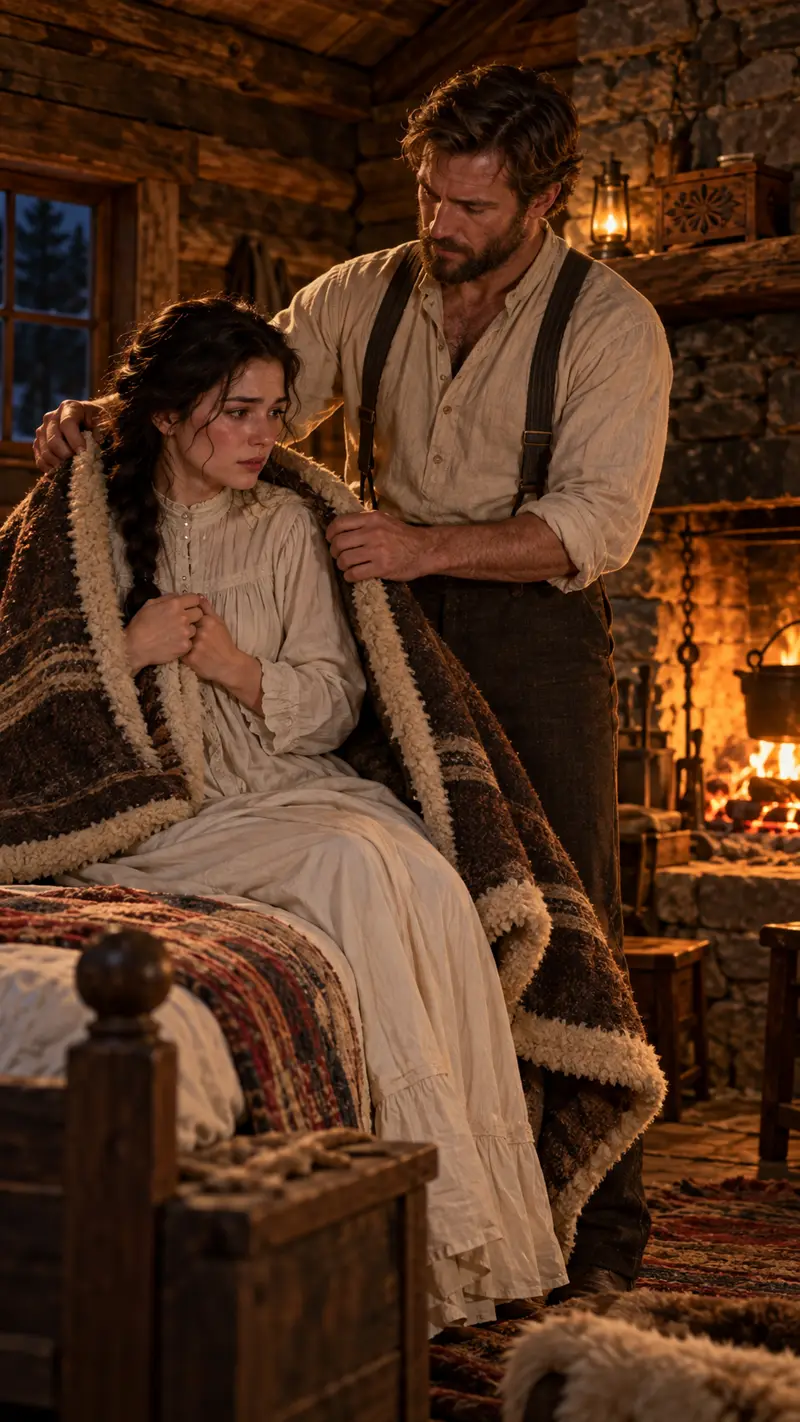
For five long days and nights a relentless blizzard raged outside, burying the cabin in drifts and sealing the valley trail. Harlan never properly slept. He kept watch from a rough stool beside the bed while the fire burned low and high again. He melted fresh snow in kettles, bathed her hot forehead with cool cloths, and patiently spooned warm herbal tea between her lips. In her delirium Miriam tossed under the heavy blankets, calling out the names of frightened children who were not there. "Please don't lock the school doors, Arthur," she wept into the shadows. "The little ones need shelter!"
Listening to her through the dark hours, Harlan understood that this brave woman had not run west out of weakness, but out of devotion. He reached down with his calloused hand and brushed the damp curls from her fevered temple, as gently as he had ever done anything. "Rest easy now, Miriam," he whispered into the quiet room. "No harm will reach you while you're on this mountain."
On the morning of the sixth day, the fever broke like winter ice giving way to the golden return of the spring sun. Miriam opened her clear gray eyes and saw Harlan slumped beside the bed, his face lined with exhaustion and relief. She reached out with a trembling hand and touched his bearded cheek, marveling at the selfless devotion of the man who had saved her. In that quiet dawn, without a single spoken promise, their marriage of convenience turned into a bond of trust and love.
By the middle of May the great snowdrifts had melted, and the rocky canyons filled with the rushing music of mountain water. Miriam's strength returned fully, and a healthy color came back to her cheeks as she planted vegetables in the garden beside Harlan. He found that his solitary heart had softened. Each evening he hurried his steps toward home, eager to see her waiting smile.
Then, on a bright Tuesday morning, their new peace was broken by the sharp ring of horseshoes on the rocky path below. Harlan set down his felling axe and stepped onto the porch just as two mounted riders rode into the clearing. The lead rider was a city man in a bowler hat and tailored overcoat, his leather boots spotless, never having touched mud. Beside him rode Deputy Sheriff Hawkins from the valley county seat, a silver badge gleaming on his worn leather vest.
The city stranger reined in, surveyed Harlan's rough clothes with open contempt, and sneered at the homestead. "I am Silas Vance," he announced, "chief legal counselor for the prominent Pemberton family estate of St. Louis."
Harlan stepped down from the porch and planted his boots in the mountain dirt, shoulders squared in cold defiance. "You've ridden uninvited onto private ground, Mister Vance," he said. "State your business."
Vance reached into his coat, drew out a thick sheaf of legal papers tied with ribbon, and held them up with satisfaction. "I hold a warrant for the arrest of the fugitive woman calling herself Miriam Whitcomb."
At that moment Miriam came out of the cabin with her head held high and walked smoothly to stand shoulder to shoulder with Harlan. Vance jabbed an accusing finger at her. "Did you truly think you could escape justice by running off to the mountains?"
Harlan shifted his large frame in front of her, shielding her from the lawyer's arrogant stare. "Speak to my wife with civility," he warned, low and dangerous, "or you'll be walking off this mountain."
Vance scoffed and turned to the lawman. "She absconded with twelve thousand dollars in municipal securities belonging to Arthur Whitcomb's surviving cousins. Do your sworn duty, Deputy, and take her into custody so we can catch the train."
Miriam laid a calm hand on Harlan's tense arm and stepped past him to face the attorney with icy composure. "Hold your tongue, Mister Vance, while the deputy examines which of us here broke the law."
She went into the cabin and was back within moments, carrying her battered leather case, which she set deliberately on the porch rail. With steady fingers she unfastened the brass buckles and lifted out a thick leather ledger stamped with official municipal court seals. "Here are certified probate records and accounting statements authorized by Chief Justice Henderson of the Missouri court," she said with clear conviction. "Every cent of Arthur's personal estate was lawfully willed to the independent trust fund he set up for his orphans."
The astonishing truth rang across the clearing: Miriam had never stolen a penny, but had given up everything to save thirty-four helpless children.
She handed the stamped papers down to Deputy Hawkins, whose weathered face grew stern as he read the judicial signatures. "The Pemberton family forged a false will," she said, "so they could tear down the children's shelter and build commercial warehouses on that ground. When I exposed their conspiracy before the grand jury, they threatened to commit me to an asylum. I had no choice."
Hawkins folded the certified papers with deliberate care, spat tobacco into the dirt, and fixed a hard stare on the lawyer. "These court documents are valid," he said bluntly, "and they prove you're trying to enforce a fraudulent claim against an honorable woman."
Vance went pale as his grand scheme of extortion fell apart under the deputy's stern gaze and her undeniable proof. Harlan stepped forward until his towering frame cast a shadow over the frightened man, gray eyes burning with righteous anger. He pulled his own marriage certificate from his pocket. "She is Miriam Beckett, my lawfully wedded wife, and this mountain is her fortress."
Without another word the deputy turned his horse toward the valley. Vance wheeled his mount in panic and fled down the path.
By the time evening twilight washed the Colorado peaks in violet, the cabin lamp had been lit again, and Harlan held Miriam in his arms, certain that the best thing that had ever happened to him had stepped off a train in the snow.