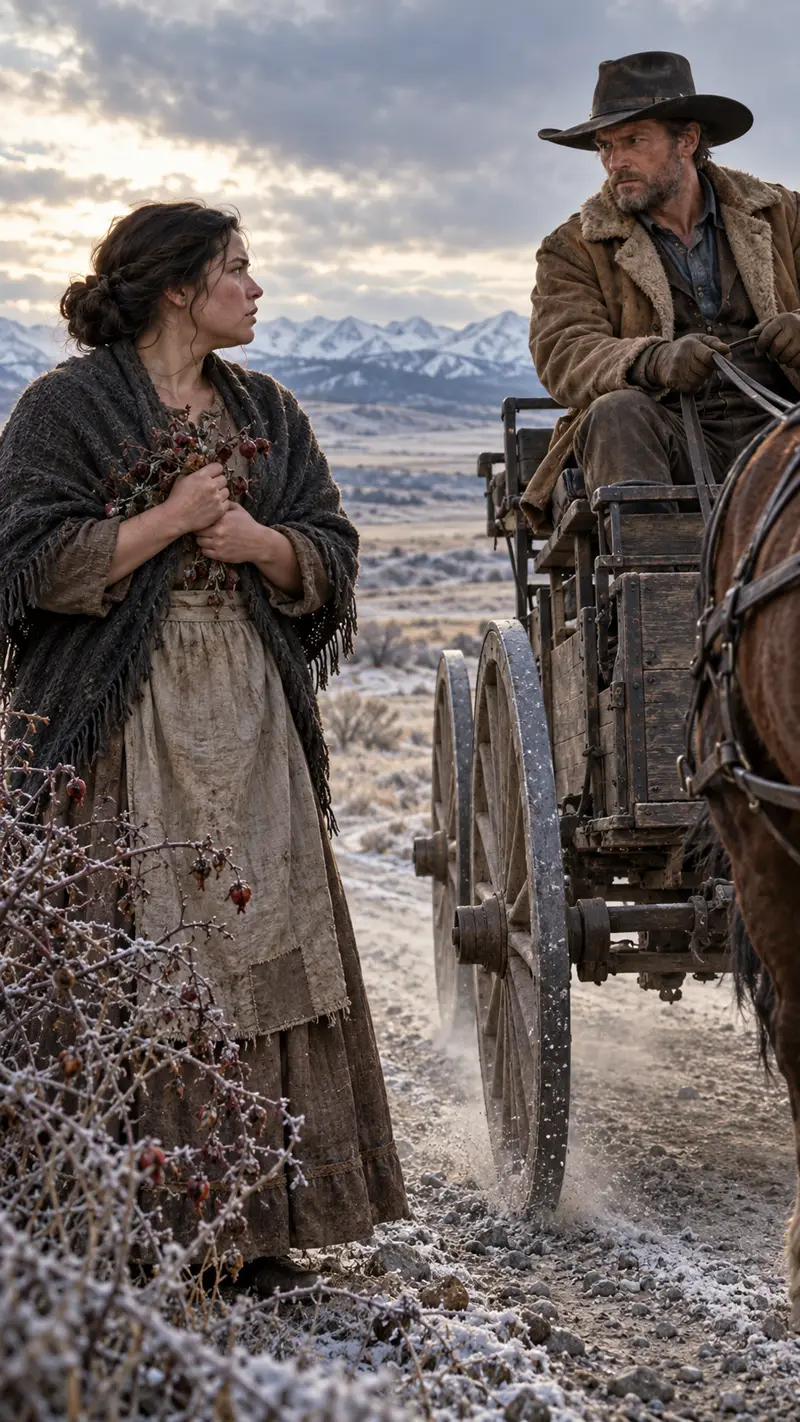
The pocketknife's edge slid under the dry hemp twine, and it parted with a faint, brittle snap that seemed to echo through the quiet cabin. Silas Rourke folded the blade away. Odette Larkin kept her eyes squeezed shut as the heavy, scratchy sack slipped up over her hair and dropped onto the wooden table between them.
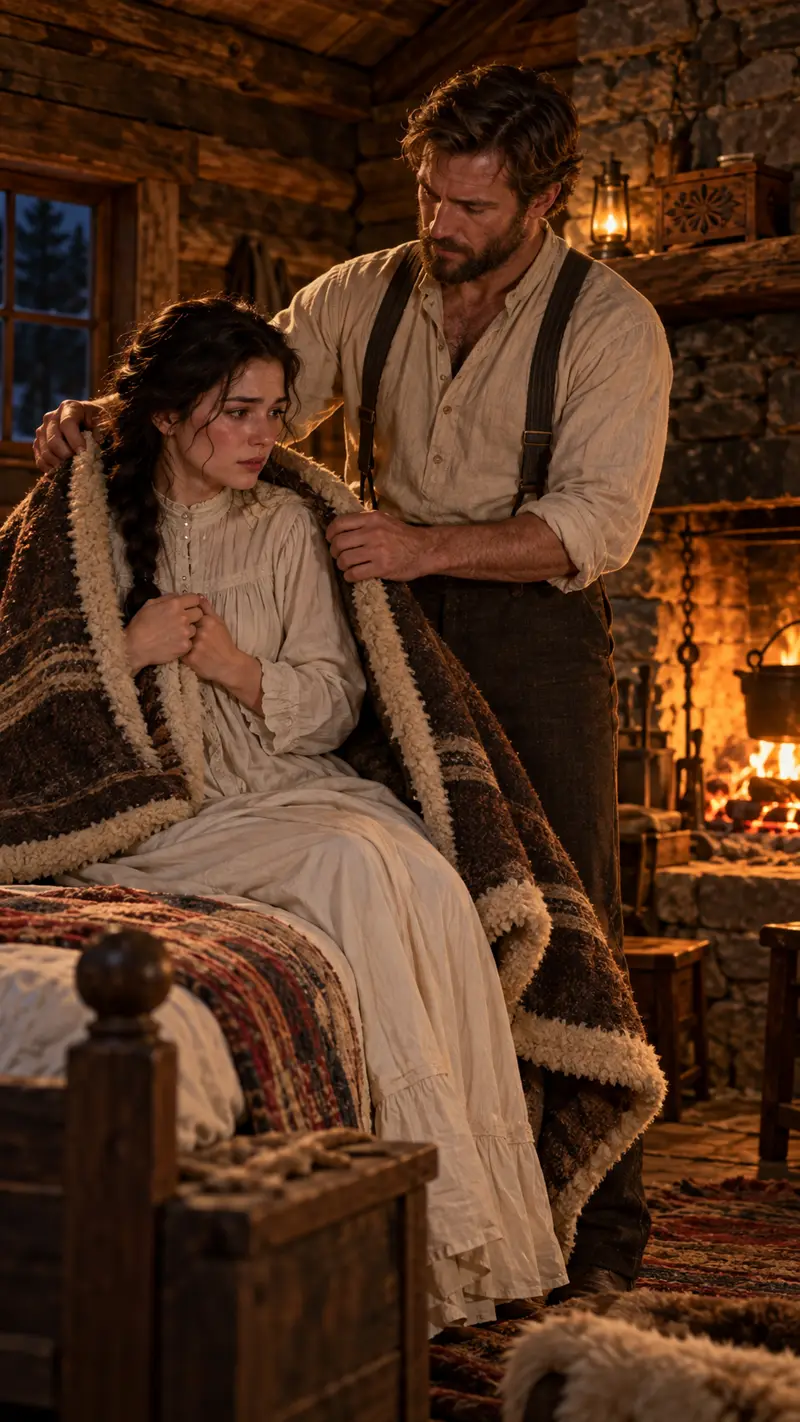
Warm air from the stone hearth brushed her pale skin. It carried the smell of pine smoke and simmering beef broth, and she shivered with sudden relief.
Silas stepped back two measured paces to give her room. His steady gray eyes took in the face that a whole frontier town had mocked without ever understanding it. A wine-red birthmark spread across her left cheek, from the edge of her dark hairline down to the soft line of her jaw, like the delicate branch of an autumn maple. She braced for the sharp breath, the quick turning away, the cruel laughter that had followed her across three territories.
None of it came. The quiet mountain man only stood there with his weathered hands loose at his sides.
Silas ladled a generous helping of steaming stew into a tin bowl, laid a wooden spoon beside it, and nudged it across the rough table.
"Tea will be steeped in a minute, Miss Larkin, but you should eat something hot before the evening cold gets into your bones," he said softly.
Odette cautiously opened her dark eyes and searched his face for the false pity or hidden disgust she had learned to expect from every man alive. She found only the quiet, weathered dignity of an older traveler who seemed to know exactly how it felt to walk alone in a harsh world.
"You don't turn away from me," she whispered. After hours of stifling silence under the coarse burlap, her voice came out husky and thin.
Silas sat down across from her and rested his broad forearms on the scrubbed pine, where lantern light threw long, warm shadows. "I've seen mountain granite scarred by centuries of frost and lightning," he said, "and I never once heard a sensible traveler call the stone ugly."
A single tear slid down her left cheek, cutting through the crimson pattern of her skin, and dropped onto her faded calico sleeve. For eight long weeks she had endured the airless heat of stagecoaches and the freezing drafts of riverboats, while men treated her like an unwelcome burden.
Silas waited in respectful silence until she had finished the entire bowl. He did not press her for explanations while she gathered her scattered courage.
"The man in Orofino called you his runaway bride before he asked fifty dollars for your passage," he said at last, low and level.
"Jeremiah Higgins never meant to make me his wife," Odette said. "Though he wrote four formal letters to my uncle in St. Louis asking for my hand. He promised me an honorable home in the West. But the moment he lifted my veil at the livery stable, his face twisted with disgust. He claimed my uncle had swindled him by sending damaged goods across the plains, and he refused to pay the freight company a penny of my coach fare. The wagon master took my coat and tied that grain sack over my head. He swore he'd leave me in the mud unless somebody paid his expenses."
"Men who judge a woman's worth by the smoothness of her skin are usually too shallow to know real strength when it's standing in front of them," Silas said.
He reached into the pocket of his heavy wool coat, then set her small canvas valise on the bench near the fire. "The debt to the freight line is settled, Miss Larkin. Tomorrow morning you can choose whatever path gives you the most peace. If you want to go back east to your family, I'll see you safely down to the rail depot in Lewiston once the weather clears."
Odette looked at the modest bag. Her face hardened with the quiet sorrow of someone who has realized, too late, that she has nowhere left to go. "There's nothing waiting for me in Missouri except an empty room and relatives eager to divide my father's estate among themselves," she confessed. "My father died last spring. He left me a small house and a share in a warehouse, but my uncle said debts had swallowed every dollar. He arranged this frontier marriage so he'd never have to look at my face again, or answer awkward questions about my father's final accounts."
Silas tilted his head, thinking. He knew the bitter taste of betrayal that had driven him into these lonely Bitterroot peaks fifteen years before. "Towns have a peculiar way of collecting selfish people," he said. "That's why I built this homestead three thousand feet above the valley floor. Up here a blizzard doesn't care what you look like, and the pines never ask you to apologize for how you were born."
He rose from the bench, pulled a thick buffalo robe from a pine chest and spread it over the rope-strung bed in the corner. "You take the bed tonight, Miss Larkin. I'll keep the fire stoked from my usual spot beside the woodbox. You're a guest under this roof, and no traveler who comes through my door gets treated with anything less than full respect."
That night a furious mountain gale rattled the cedar shingles overhead, and Odette slept safely for the first time since she left the banks of the Mississippi.
By morning four feet of fresh powder had sealed the narrow pass and buried the spruce boughs in glittering drifts. When Odette opened her eyes, coffee was bubbling on the stove and a pan of skillet bread was baking to a crisp golden crust. For the first time she could remember, someone had seen the crimson patch on her cheek and had not spoken one cruel or dismissive word.
"You don't need to work for your keep while the storm keeps the pass closed," Silas told her as he carried in armfuls of firewood.
"Work is no punishment in a home where a person may breathe without fear, Mr. Rourke," she answered with quiet dignity.
In the days that followed, the small cabin became a sanctuary of shared chores and unspoken warmth against the winter storms raging outside. In the evenings they talked about simple things: geese flying south in autumn, the clear trout streams of the Clearwater River, the books her father had loved.
On the seventh afternoon of the snowstorm, Odette opened her weathered canvas valise by the fire to mend the torn lining along its leather bottom. As she pushed thick thread through the stiff trim, her needle struck something hard and folded, hidden deep in the double pasteboard backing. She frowned, borrowed Silas's pocketknife, and pried back the dry paste that had sealed the compartment for years.
Beneath cracked oilcloth lay a thick packet of heavy parchment documents, bearing the red wax seal of the St. Louis Probate Court.
Her breath caught as her eyes raced over the elegant black calligraphy in her late father's steady, familiar hand.
"This is my father's true will," she whispered, trembling. "Signed and registered three weeks before he died in the city hospital. My uncle told everyone my father died penniless. But this paper plainly leaves me the deed to our river warehouse and two thousand dollars in bank stock."
Clipped to the will was a folded draft on heavy vellum, a private agreement signed by both her uncle and Jeremiah Higgins himself. Silas rose, came to the table and read over her shoulder as the cruel scheme of the men in St. Louis laid itself bare. Higgins had never been a stranger seeking an honest frontier wife. He was an associate of her uncle, and he had agreed to secure her signature on a release form. Once Odette had signed her inheritance away to her husband under territorial marriage law, Higgins was to collect eight hundred dollars as his fee.
"He never turned you away because of your face, Odette," Silas said quietly. It was the first time he had used her given name, and he said it gravely. "He drew that crowd in Orofino because he panicked when he found out you'd come west without the signed papers he needed. By putting a sack over your head and calling you a monster, he made sure the town would shun you and drive you off before you started asking questions."
Odette stared at the documents with her fingers pressed to her trembling lips as the full weight of the deception hit her. "They took my father's legacy and made me believe I was too hideous to walk among ordinary people," she said, her voice steadying with sudden resolve.
Silas laid his large, warm hand over her shaking fingers. His gray eyes burned with a fierce, protective fire. "The circuit judge comes to Orofino every other Wednesday. By tomorrow morning the trail should be clear enough for two good horses. If you're willing to face that town once more, I'll ride beside you every foot of the way until your father's name is cleared."
"I'll go with you," Odette said firmly. "And this time nobody will ever put a cloth over my head again."
Miners and storekeepers stopped on the wooden steps and stared in open surprise as Silas Rourke rode proudly down the middle of town. Beside him rode Odette Larkin, sitting tall in her woolen cloak, her dark hair pinned beneath a plain straw bonnet that left her face completely bare. She did not look at the ground. She did not flinch when children whispered or when men nudged each other along the freight office porch. She held her chin high, her dark eyes clear and calm, and met the town's stares with a grace that hushed the gossip.
Outside the territorial courthouse, Thaddeus Cooper, the freight agent who had demanded her passage money, stopped dead with a bill of lading in his hand. Before he could say a word, Jeremiah Higgins pushed through the swinging doors of the miners' saloon across the muddy street. He froze. The color left his face as he recognized the woman he had mocked in public and abandoned to the winter. Then he saw the legal portfolio tied with red ribbon under her arm, and his arrogant stance crumbled into plain panic.
Silas dismounted smoothly, offered his gloved hand to Odette and guided her up the stone steps of the county registrar's building. Higgins rushed across the mud, his voice cracking with desperate bravado, and tried to cut them off at the double oak doors. "You've no business here, Larkin! You've no standing to make claims in this county after running off with a hermit!"
Silas stepped between them like a pillar of mountain granite. His broad chest blocked the doorway, and he never raised a hand or his voice. "The lady has business with Circuit Judge Albright. You'll step aside, or I'll ask the territorial marshal to clear this threshold."
Inside the courtroom Judge Albright adjusted his spectacles and took the sealed papers from Odette's gloved hands with thorough professional curiosity. The room went utterly still as he examined the St. Louis court seals, the registered property deeds and the private agreement bearing Higgins's signature.
Judge Albright lowered the papers, fixed a piercing stare on Jeremiah Higgins, and declared that a warrant for fraud would be issued before sundown.
"These documents establish beyond doubt that Miss Odette Larkin is the sole legal beneficiary of her late father's estate and business holdings," he announced. "Further, Mr. Higgins will return every dollar of the travel funds he took under false pretenses before he is escorted across the territory line."
Thaddeus Cooper hurriedly slid the fifty-dollar pouch of gold dust back across the cedar desk to Silas, desperate to escape the court's wrath. Silas pushed it straight on to Odette, making sure that every cent of her dignity and rightful property stayed in her own hands. The townsfolk crowded at the back of the courtroom began to whisper in shame, remembering the laughter they had thrown at an innocent woman. Odette signed the territorial registry with a steady hand and took back her father's legacy and her freedom under the protection of the law.
An hour later they stood together on the wooden platform of the Orofino staging depot, where the afternoon stagecoach to Lewiston was getting ready to leave. With her recovered inheritance deposited in the territorial bank, Odette had the means to go wherever her heart wished. She could buy a first-class ticket to San Francisco, return to St. Louis to face her uncle, or live in comfort in any fine eastern city.
Silas set her small valise by the coach door. His tall frame stood dark against the sweep of the snow-capped Bitterroot peaks. He kept his hands in the pockets of his heavy coat, fighting the hollow ache that had settled in his chest since the courtroom.
"The stage will reach the river steamer in Lewiston by tomorrow evening, Miss Larkin," he said softly. "From there you can travel wherever the world looks bright."
Odette looked at the waiting coach. Then she looked back at the mountain man who had walked five hours through a blizzard to make sure she had shelter. "You think I came into town today just to find a way out of these mountains, don't you, Silas?" she asked quietly.
He swallowed hard, and his weathered face showed the quiet pain of a solitary man long used to losing whatever he dared to care for. "You're an educated woman of means now. You belong in a parlor with soft carpets, not in a lonely cabin ringed by snowdrifts. I brought you down here so you'd have your choices back. No honest man would ask you to stay in the wilderness out of gratitude."
Odette took two deliberate steps and closed the distance until she could see the warmth in his steady gray eyes. "Gratitude is a debt people pay for a service, Mr. Rourke. What I feel standing beside you has nothing to do with debts or fifty-dollar receipts."
She lifted her bare hand and laid it gently against the weathered skin of his cheek, her fingers resting beside his own pale, silent marks. "In a world full of wealthy gentlemen, not one had the honor to look at my true face without disgust. But you saw my soul before you even knew my name."
She turned to the waiting driver and told him, with a firm, joyful smile, to take her valise down from the coach rack. Silas stared at her in stunned wonder. A slow, radiant smile broke over his weathered features as he understood that she was choosing him of her own free will.
Hand in hand, they turned their horses away from the noise of the town square and set out for home, toward the peaceful heights of the Bitterroot Mountains.