One mountain winter would test the vows two wary, lonely strangers had spoken with so much hesitation. Only when a shadow from the past reached their cabin door did they learn what devotion really meant.
Gideon Pike staggered across the split-log threshold, and his broad shoulder knocked the doorframe as the mountain storm roared in behind him. The iron latch rattled under his frost-stiff fingers until the thick cedar slab finally slammed shut against the swirling Montana dark.
Miriam let her brass mending shears fall onto the hearth rug. Her heart pounded as she hurried across the room to him.
His face had gone white from the bitter cold, and frozen sleet had plastered his dark hair to his forehead. In his right palm, squeezed so tight that his knuckles stood out stark white, lay a heavy brass button bent almost in half. She knew that polished metal at once. It was the top fastener she had stitched onto his woolen hunting coat only last week.
“Gideon, please sit down before your strength gives out,” she begged softly, slipping her hands under his arm to guide him to the fire.
The tall frontiersman sank onto the split-log bench, his big chest heaving in deep, ragged gasps as the heat reached him.
Looking down at his bowed head, Miriam felt an old memory rise up from their very first evening together. She had sat rigid beneath the thick bison pelts in this quiet cabin, every muscle locked with fear after she finally spoke it aloud. “It hurts,” she had whispered into the cold dark of their wedding night, her voice breaking under the weight of her old dread.
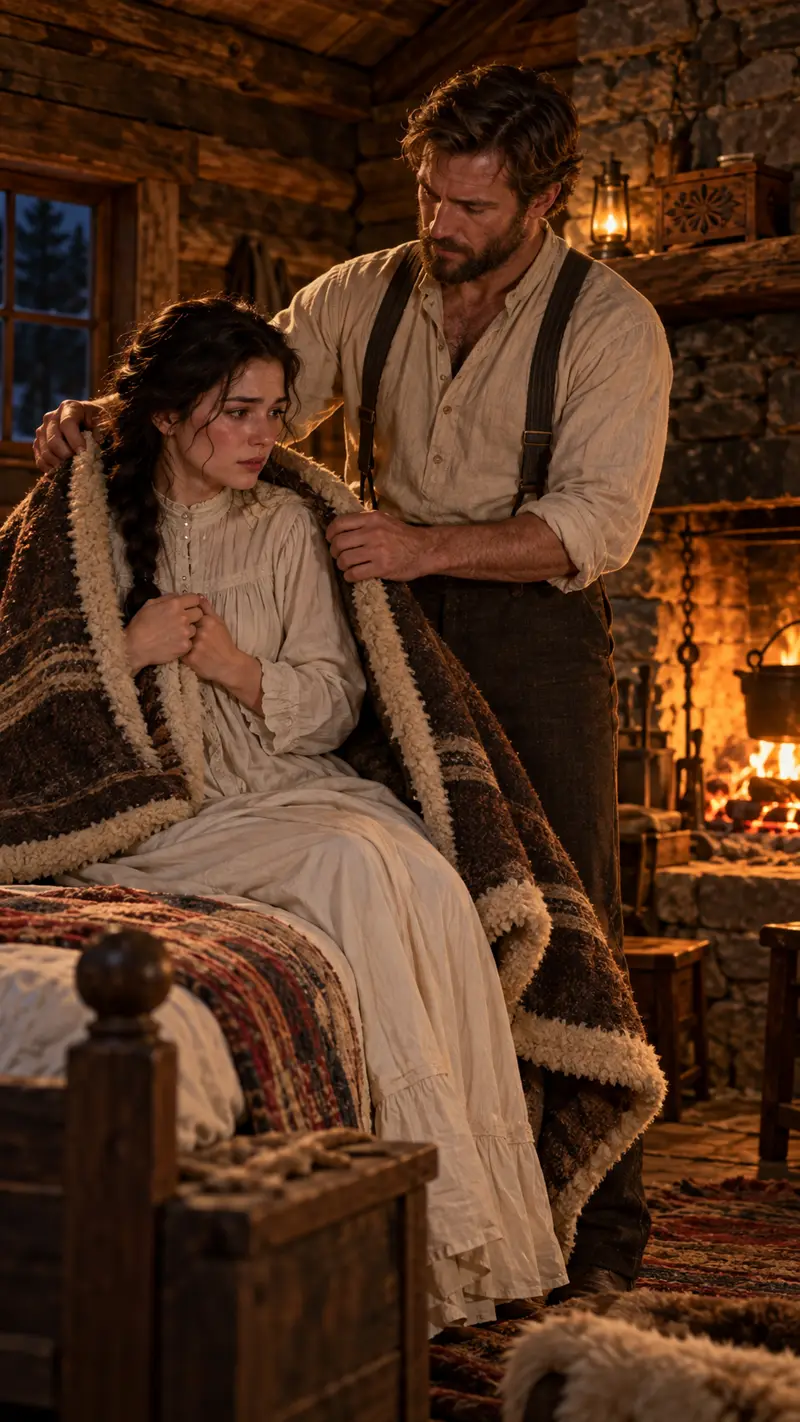
She had lowered her eyes and braced for anger, because the overseers of the Massachusetts textile mills had taught her to expect only harsh demands. But Gideon had not raised his voice. He had not reached for what the contract said was his by right. He sat on the edge of the bed with his head in his hands while the logs burned low. Then he drew the thick wolf pelt gently over her shivering shoulders, crossed the floor on quiet feet to tend the dying coals, and spent the whole long night awake in his wooden rocking chair, asking nothing of the frightened city orphan.
For seven grinding years in the dusty factories, Miriam had spun thread until her hands ached, and she had learned that every kindness came with a price. When Gideon’s formal letter and her railway ticket arrived in Boston, she expected just another stern master who saw her as free labor. She stepped off the western stagecoach believing that survival out here meant enduring an endless string of harsh, unforgiving demands.
The next evening, though, Gideon noticed her flinching near the cast-iron stove. He set his knife down at once and crossed the room. He had seen the blister the hot skillet left on her that morning, the one she had tried to hide. He did not scold her for being careless. He opened his cedar chest and took out clean linen strips and an amber bottle of pine balsam.
“Sit down and rest your hands,” he said, so gently that his deep voice calmed her. He bathed her sore skin in cool mountain water and spread the herbal salve with the patient touch of a veteran craftsman. “You can choose when you’re ready,” he told her in the firelit room, looking into her eyes without a flicker of resentment. “There is no debt to pay in this house.” His calm words hung in the air like a promise.
The marriage certificate folded in her leather trunk had felt like a trap when she signed it before the magistrate. But through the quiet weeks of winter that followed, the two of them fell into an easy rhythm. They shared warm skillet bread at dawn and worked side by side until dusk. She learned to listen for the steady beat of his axe outside and found deep comfort in knowing he was near. Gideon never pushed past the limits she set. He treated her wishes with a respect that slowly took apart the walls around her heart. She caught herself watching his broad back as he mended leather harness by lamplight, admiring the gentle spirit under his rough exterior. The dread that had poisoned her thoughts began to melt away, and a steady, surprising affection grew in its place.
Then the terrible December blizzard swept down from the northern ridges. Shrieking winds raced over the timberline and shook the whole log cabin. Drifts piled against the spruce walls, and the sloping cedar roof was in danger of buckling under hundreds of pounds of packed snow. Gideon strapped on his rawhide snowshoes and climbed a sturdy ladder with a wide cedar shovel to clear the rafters. Below, Miriam threw her whole weight against the heavy door, fighting with all her strength to hold it against the gale.
Without warning, a sharp crack rang out from the granite ridge above the cabin, and a huge shelf of packed snow gave way. A colossal wave of white powder roared down the rocky slope, swallowed the rear porch, and swept Gideon off the ladder.
Miriam screamed into the storm. She abandoned the door and plunged waist-deep into the freezing drift without a second thought. The wind tore at her woolen skirt, but she dropped to her knees and dug frantically through the hard crust with her bare hands. Her fingertips went numb and her breath burned in her chest, yet she would not stop calling his name into the whiteout.
Just when exhaustion was about to beat her, a large leather mitten burst through the snowpack and clamped around her wrist. With a desperate heave she pulled backward, helping him drag his upper body out into the bitter daylight. Stumbling, clinging to one another against the howling wind, they struggled back over the threshold and dropped the oak bar.
She piled dry pine logs on the fire until it crackled with steady heat and wrapped thick wool blankets around his shivering frame. As she knelt beside him with warm tea and watched his breathing slowly settle, an overwhelming truth rose in her. She was no longer afraid of losing her independence to the marriage contract. She was terrified of losing the selfless man who had sheltered her soul when the rest of the world offered only indifference. That brush with death had knocked down the last wall between them and left behind a fierce loyalty that held her heart completely.
Three weeks later the dried venison was nearly gone and the passes were still choked with snow, so Gideon announced that he had to hunt. He left before the first gray light touched the ridges, carrying his long rifle and a small ration satchel.
Miriam spent the lonely hours feeding the fire and staring through the frosted glass at the empty length of the trail. Near midday a single sharp rifle shot rolled across the distant limestone peaks, and she knew he had found game. She set a pot of vegetable broth to simmer, expecting his familiar shape to appear along the ridge before dark.
Dusk fell over the wilderness with no sign of him, and the old knot of dread tightened in her chest. When heavy, dragging boots finally climbed the timber steps of the porch, she let out a ragged sob of relief.
But as he crossed into the lamplight and collapsed against the table, the sight of his hollow, worn face chilled her. His hand was still locked around the twisted brass button, as though he could not let it go. Kneeling beside him, Miriam used her warm fingers to pry his stiff ones open, one by one. The button rolled onto the pine tabletop, its anchor design twisted into a sharp curl by some immense, frantic effort.
“Gideon, please tell me what happened on the ridge,” she whispered, pressing a cup of hot broth into his cold, shaking hands.
He drank in slow, careful swallows, his deep gray eyes fixed on hers, full of sorrow. “I brought down a healthy elk by the western clearing, Miriam. Enough meat to carry us through the rest of the winter.”
“Then who tore this off your coat?” Her voice trembled as she lifted the warped button into the lamplight.
“A traveler was waiting at the lower gorge crossing, where the stagecoach trail meets the mountain pack path,” Gideon said gravely. “He was riding a livery gelding from the settlement and carrying a leather portfolio stamped with the mark of a Massachusetts merchant bank.”
A chill ran down Miriam’s spine, and the dark memories of the eastern mills rushed back to overwhelm her.
“His name is Thaddeus Vance,” Gideon said, watching her eyes widen as she recognized the feared and hated city agent.
Vance was chief collector for the Boston mill syndicate, a ruthless man who had hounded poor families with legal tricks. After her father died he had chased Miriam through the city alleys, insisting that an old mechanical contract made her labor the company’s property.
“How did that terrible man find where I ran to?” she asked, clutching Gideon’s sleeve in rising panic.
“He traced the ticket manifest from the railway station in Chicago. He’s set on collecting what he falsely calls an unpaid debt.”
Vance had stopped Gideon on the mountain trail and waved a yellowed company ledger, claiming that Thomas Foster had died owing four hundred dollars. He had declared with great arrogance that Miriam was legally bound to return east and work in the spinning rooms until the balance was cleared. A territorial deputy would climb the steep pass with him at the first thaw to take her into custody. When Gideon would not give ground, Vance grew desperate, since his big commission would vanish if he went back to Boston empty-handed. He lunged and grabbed the lapels of Gideon’s coat, trying to wrench him toward the edge of the canyon. The violent yank ripped the heavy brass anchor button clean off the thick wool.
Gideon never raised a hand in return, and never touched the rifle slung across his shoulders. He simply stood as firm as the granite peak beneath their feet, and his calm exposed the collector’s threats for the empty bluster they were. With one composed sweep of his forearm he broke the agent’s frantic grip and sent the man stumbling into a deep snowbank. The leather portfolio fell into the drift and spilled its fraudulent papers across the icy trail, where the wind scattered them.
“I didn’t need force to dismiss his empty claims,” Gideon told her softly, unbuttoning his heavy woolen vest to reach inside.
From an inside pocket close to his heart he drew a flat oilcloth packet, perfectly shielded from the mountain damp. He untied the braided sinew with great care and laid three crisp sheets of parchment on the clean cedar grain of the table.
The top document bore the imposing scarlet wax seal of the Massachusetts Superior Court, stamped and signed months before Miriam left the city. It was an official legal release declaring that every financial obligation ever attributed to Thomas Foster was fully satisfied and closed by law. Miriam stared at the page in disbelief, her trembling fingers tracing her father’s unmistakable signature at the bottom.
“When Vance saw that court seal,” Gideon recounted quietly, “his bluster vanished into the freezing air like steam from a kettle. I told him that if he ever set foot in this county again, the district magistrate would sentence him to hard labor for fraud.” The collector had scrambled back into his saddle and turned down the pass toward the valley settlement in complete disgrace.
“So the debt is truly gone forever?” Tears of relief welled in her eyes and spilled down her cheeks.
“There never was a lawful debt, Miriam.” Gideon reached across the table to gently dry her face. “The mill syndicate invented those ledgers to scare orphaned girls into signing endless work contracts that kept them trapped in poverty.”
Yet as she looked over the official papers, another deep mystery stirred in her, and she needed the quiet frontiersman to explain. How could a reclusive hunter living in the high Montana wilderness get court releases from the highest judicial authority in Massachusetts?
Gideon smiled faintly, his weathered face softening, and reached deeper into the oilcloth pouch for an older, yellowed letter. “Before your father moved your family to Boston to find treatment for his lungs, he and I were partners along the river.”
Miriam gasped softly as distant childhood memories came back: a sunlit cabin by rushing mountain water, and two tall men laughing together.
“Thomas Foster was the truest friend I ever had. He hauled me out of an icy river when my canoe capsized, years ago. When his health failed in the city, he mailed this last letter to my trading post and trusted his beloved daughter to my care.”
Gideon spread the fragile letter open, and her father’s familiar, elegant hand showed in dark walnut ink across the page.
“Gideon,” her father had written, “if the world turns cruel to my gentle Miriam, give her a haven where her spirit can flourish.”
Miriam pressed both hands to her mouth as a sob of gratitude and bittersweet sorrow broke through her as she read.
“I searched for you for two years after he passed,” Gideon admitted quietly, his deep voice thick with honest feeling. “I used every ounce of gold dust I had panned from the northern streams to settle the false claims filed against his estate. I knew those greedy mill owners would never let you leave unless the clerk of courts had signed every line of the ledger.”
“You spent all your savings on a woman you hadn’t seen since she was a little girl?” she asked in awe.
“I made a solemn promise to the finest man who ever walked these hills,” he said, looking at his large, calloused hands.
“Then why send for me as a bride, instead of just inviting me here as his daughter?” she asked softly.
Gideon paused, and the earnest vulnerability in his gray eyes laid bare the deepest rooms of his solitary heart. “A single woman traveling alone across these rugged territories has very little legal protection under territorial law,” he answered with gentle seriousness. “Marriage was the strongest shield the law offered to protect your name and keep your father’s land claim safe. But on our wedding night, when you whispered that it hurt, I felt ashamed that I had caused you even a moment of sorrow.”
He lifted their official marriage certificate out of the cedar chest and laid the sealed parchment gently between them on the table. “When the spring thaw clears the lower trails, the stagecoach can take you wherever you wish, with five hundred dollars in gold. You’re free to leave this mountain and choose your own path. You owe this cabin nothing.”
Miriam looked at the paper, then raised her eyes to the honorable man who had given everything to shelter her from the world. Without a word, she took the certificate and laid it across the glowing birch embers, watching the paper curl into silver ash.
“I’m staying because I love you,” she whispered, wrapping his weathered hands around the bent brass button as devotion filled the cabin.
Outside, the mountain wind sang softly through the pines and left a tranquil hearth behind, where two willing hearts began their life together.