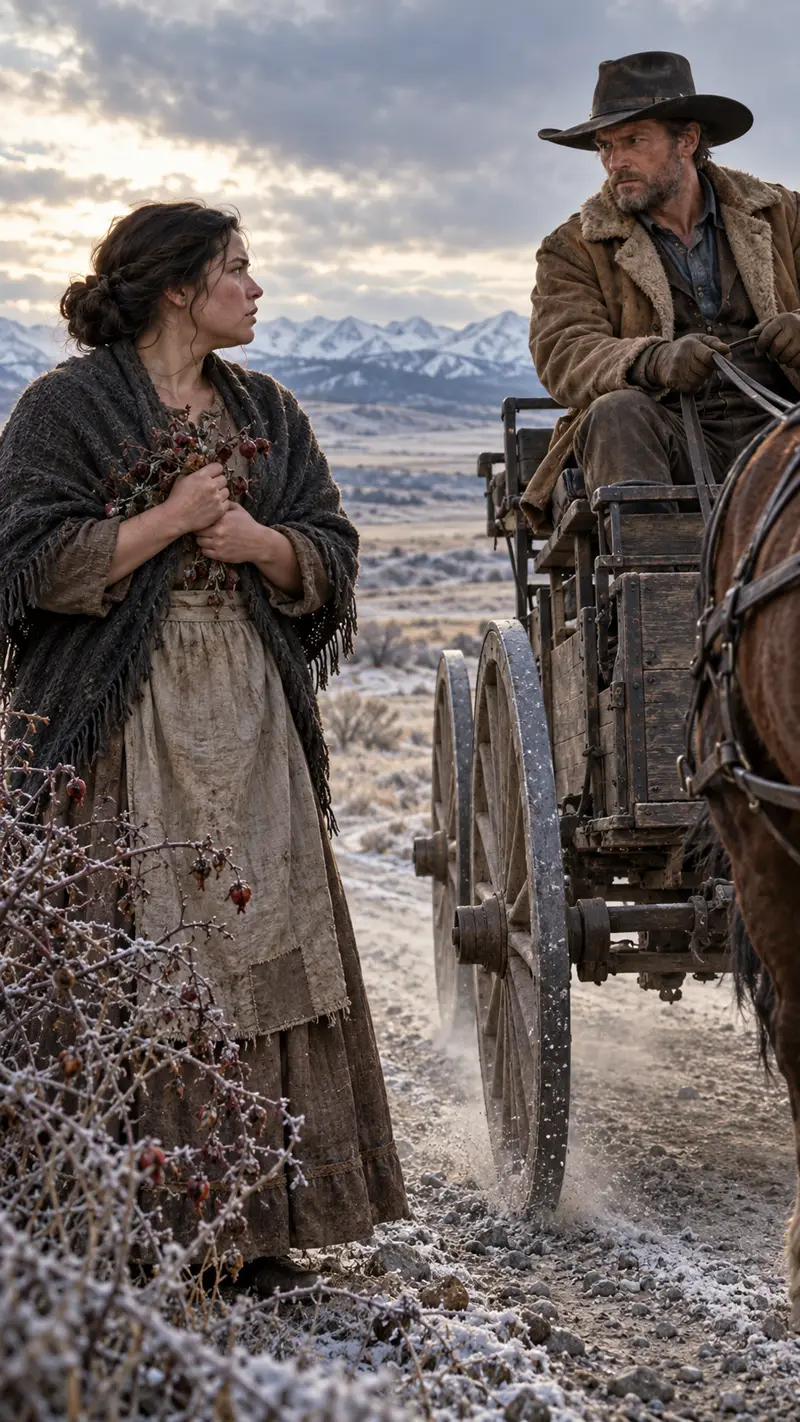
Beatrice Dorsey stood by the weathered corral fence in Alder Creek, and the autumn morning bit at her cheeks with a sharp mountain chill. Her son Martin sat frozen on the cedar rail, small knuckles white, while Abram Kincaid's broad hand rested on the wood beside him. The old mare blew a soft breath over the boy's outstretched fingers and nickered into the quiet timber.
"Martin Dorsey, step down from that fence right now and don't trouble Mr. Kincaid with your games," Beatrice called anxiously.
Martin dropped his eyes. The rare wonder drained from his face, and he got ready to jump down into the dusty grass. Abram did not pull his hand away, and he would not let the frightened boy slide into shame he hadn't earned.
"A boy who wants to learn about horses is no trouble, Mrs. Dorsey," he said with steady warmth. "An eager partner makes the morning chores a lot less lonely."
Beatrice pressed her hands together under her faded apron. She could find no words to shield her family from disappointment. Behind her, ten-year-old Tessa stayed rooted on the barn path, keeping watch over little Millie. Millie hugged her patched rag doll and hid her face in her sister's skirt as the tall rancher turned.
Abram lifted Martin down from the rail and set his boots on the ground with quiet patience. "Run along inside and help your sister wash up for breakfast, Martin," he said, tapping the boy's small shoulder. The three children hurried up the wide steps. That left Beatrice alone with the rancher under the huge Montana sky.
Two days earlier, Don, the elderly stage driver, had unloaded their battered trunks and rolled away down the southern road. Those few trunks, three hungry children and a prayer for survival were all Beatrice had brought to Alder Creek.
"You don't have to indulge them, Mr. Kincaid," she whispered, her throat tight around the memory of broken promises. "I promised in my letters they would never be an inconvenience to your household or your work."
Abram glanced at her worn leather boots and saw the fierce protectiveness of a woman who had fought hard against despair. "A home without the noise of living children is just an empty barn made of painted boards," he said kindly.
Inside the kitchen the iron woodstove gave off a steady warmth that smelled of roasted oats, apples and pine kindling. Ever since the family's tired feet crossed the ranch house threshold, Beatrice had drilled the children on how to behave. That very morning in the upstairs hall she had told them firmly, "Don't run in Mr. Kincaid's quiet house." Then, urgently, in a whisper: "Keep your voices down, and be grateful for every kindness he offers." Tessa had obeyed without question. Martin had tried. Little Millie had gone strangely quiet under the constant warnings.
At the table Beatrice kept a close eye on her children so no spilled water could upset their host. Then three-year-old Millie tipped her tin cup by accident, and water raced across the scrubbed pine toward Abram's napkin. Beatrice shot to her feet with a gasp and grabbed for an old cloth in her apron.
"I'm so sorry, Mr. Kincaid. She's still clumsy with her little hands," she pleaded, her chest tight.
Abram simply took his own dry cloth and pressed it on the spill, chuckling low and reassuringly. "If a spilled cup of water was the worst disaster this kitchen ever saw, I'd count myself truly blessed."
Tessa watched him over her wooden bowl, her sharp eyes searching his weathered face for any hidden irritation. For two hard years in Missouri she had watched distant relatives treat the family's grief like an unpaid debt.
When the meal was cleared, Abram went to the corner hutch and took a pair of small leather work gloves from a shelf. "Martin, if your mother allows it, I could use a partner to help me check the grain bins before noon."
Martin looked at his mother with longing. His shoulders eased only when she gave a slow nod.
All morning Beatrice scrubbed the cast-iron skillets until they shone, pouring her nervous energy into work. She felt an urgent need to prove her worth. She was terrified that idleness might make Abram regret taking in four penniless mouths. Through the window drifted Martin's bright laughter, mixed with Abram's patient voice. The rancher was showing him how to sift sweet oats, and he never hurried the boy when small hands fumbled and spilled grain.
Meanwhile Abram had quietly left a leather-bound book of frontier maps on the parlor bench where Tessa sat embroidering. He never told her to read it. By midday she had set down her needle and begun turning the pages. When Abram stopped at the parlor door to wash the dust from his arms, he smiled at the sight of her reading. Trust, he knew, gets built one quiet plank at a time.
Three days later the autumn wind sharpened and brought the smell of winter down from the high peaks. Abram hitched his two black draft horses to the spring wagon and announced that they needed supplies before the mountain froze. Beatrice dressed the children in their best mended wool coats and told them to stay close on the town boardwalks.
As the wagon rolled down the main street of Alder Creek, townspeople paused outside the mercantile to stare. A mail-order bride arriving with three fatherless children was strange news in a valley where ranchers rarely took on such burdens. By the feed store porch a wealthy cattle broker named Harlan Cole leaned against a post and watched the wagon come. For two long years Cole had tried to buy Abram's prime valley pasture, waiting for the lonely rancher to give in.
"Looks like you found yourself a whole crew of field hands at the stage station, Abram," Cole called out mockingly.
Beatrice stiffened on the high wooden bench and clutched her skirt, stung to the core. Abram set the iron brake lever with a deliberate click and faced the broker without raising his voice. "I found a family, Harlan. A man can't buy that with gold or measure it by the acre."
He reached up to help Beatrice down, holding her hand with deliberate respect in front of the watching crowd. In the mercantile he bought thick wool blankets, writing slates for the children and a bright blue ribbon for Millie. Beatrice objected to each purchase in quiet desperation, insisting her children had enough and could do without luxuries.
"A girl ought to have a bright ribbon, and young minds need slates to practice their letters," Abram told her gently.
While they were loading flour sacks into the wagon bed, Harlan Cole came up to the hitching post with a sour glare. "You're making a foolish wager, Kincaid, spending good silver on mouths another man left behind in Missouri. Winter in this territory is unforgiving. When the snow stacks high, you'll wish you'd taken my cash offer."
Abram stepped up until his broad chest was inches from Cole's, his jaw set like granite in a creek bed. "My timberland will keep this family warm, and my pasture will feed their cattle long after your greed runs dry."
Cole scoffed and backed away, but the look he threw at Beatrice promised the matter was far from settled.
The ride home was silent, with the afternoon light fading fast behind the dark ridges. Beatrice stared at Abram's sturdy hands on the leather reins, her thoughts racing with guilt over the hostility they had stirred up. "Mr. Kincaid, if our presence brings trouble from your neighbors, we can leave on the next stagecoach south," she offered.
Abram halted the team on the ridge crest and looked out at the smoke curling up from his chimney. "I spent ten years watching that smoke rise into an empty sky, Mrs. Dorsey. I won't give up my peace."
The promised storm came down from the northern mountains the following Tuesday, sudden and blinding. Icy gusts raked the pine timber, rattled the heavy windowpanes and flung dried leaves around in frozen spirals. Martin had been gathering pine cones in the lower orchard, with little Millie toddling happily beside him under the branches. When the first pellets of sleet hit the kitchen glass, Beatrice hurried to the back porch to call them in.
Martin came running through the gale with an armful of kindling, his small face pale with terror. "Mama, Millie dropped her doll in the tall grass by the creek, and she ran after it!"
The air left Beatrice's lungs in a gasp as she stared into the blinding gray squall. The willow creek was running swift and cold with autumn runoff, edged by thick brush and slick mud banks. She did not stop for her shawl. She plunged down the porch steps into the freezing wind, screaming her daughter's name.
Abram burst out of the barn on his great black gelding and leaned down from the saddle, his voice commanding and clear. "Beatrice, stay by the porch with Tessa and the boy so I know where you are!" He turned the horse toward the gulch.
Before Beatrice could protest, the horse surged into the squall, and Abram's broad wool coat vanished into the frozen gloom.
She huddled on the porch with Tessa and Martin pulled close, praying with every frantic breath for her baby. The minutes dragged into an agonizing eternity. The wind tore through the valley and coated the fence posts in white frost.
Down along the creek bed, Abram pushed through tangled willow branches, following small footprints that the sleet was fast erasing. He found Millie curled in the hollow base of an ancient cedar, shivering hard and clutching her soaked doll. He did not hesitate. He pulled off his heavy sheepskin coat and wrapped the crying child in the warm, dry wool, then held her tight against his chest, shielding her from the bitter wind with his own body all the way back.
When the black gelding came out of the swirling white fog, Beatrice sank to her knees in the sleet, weeping. Abram swung down and set the bundled, warm child in her shaking arms. Millie tucked her cold nose against her mother's neck and whispered that Mr. Abram had saved her favorite rag doll.
Abram's face was pale. His lips had a faint blue tint, and his hands were numb from riding without a coat. Tessa stepped forward without a moment's thought, took his stiff hands into her small wool mittens and rubbed them with frantic care. "Come inside by the hearth, Mr. Kincaid, before the frost gets hold of you," she urged, her voice trembling. For the first time since they arrived, the ten-year-old looked at the rancher with pure, devoted trust.
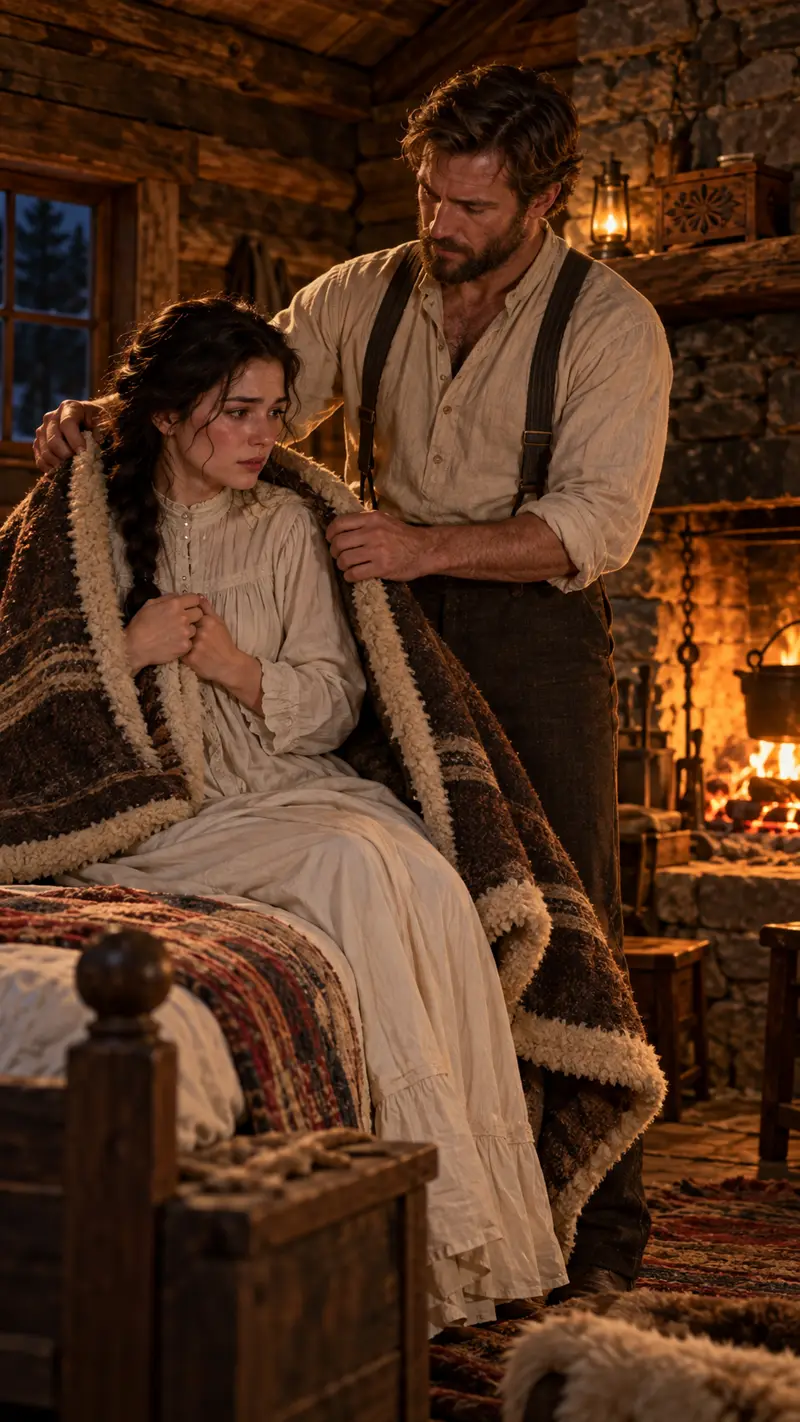
Inside, Beatrice built up a roaring fire with split pine, set iron kettles to heat and wrapped Abram in quilts. Martin sat by the hearth feeding sticks to the flames, watching Abram with the awe children keep for heroes.
When the children were tucked into their warm featherbeds upstairs, Beatrice went back to the parlor for an extra blanket. The door of Abram's private study stood a little open, and the amber glow of a kerosene lamp spilled across the floor. On the cedar writing desk an open wooden ledger box sat beside a stack of official papers tied with ribbon. She went in to take the blanket from a chair, but the neat handwriting on the top page caught her eye.
Spread under the lamplight were all the letters she had sent from Missouri, their worn folds carefully preserved between sheets of parchment. Beside them lay pencil sketches in Abram's hand, plans for a sturdy porch swing and study desks. Under the sketches lay an official parchment with the golden seal of the territorial court at Helena, dated three weeks before her arrival.
Beatrice leaned close and her breath caught as she read the precise legal lines in black ink. Abram had deeded full co-ownership of the Kincaid Ranch to Beatrice Dorsey, granting her permanent title to the land. More astonishing still, the paper named Tessa, Martin and Millie as his sole lawful heirs to every acre. He had bound his whole life, his property and his name to four strangers before he ever heard their voices.
She stood motionless in the dim study as hot tears ran freely down her face, overwhelmed by his quiet generosity.
"You ought to be resting by the hearth, Beatrice," a gentle voice murmured from the doorway.
Abram leaned against the cedar doorframe in his wool quilt, his gray eyes soft with understanding. Beatrice lifted the heavy document in trembling fingers and spoke in barely more than an aching whisper against the storm. "Why would you sign away everything you worked ten years to build to a woman and three children who brought you nothing?"
He crossed the room slowly and stopped beside the desk where her letters lay under the golden lamp. "You brought everything this ranch has lacked since the day I drove my first fence post into this valley," he said. "When I read your letters, I didn't see a burden looking for charity. I saw a mother of extraordinary courage, who crossed a whole continent to give her children hope. I wanted you to know that whatever happened to me, no greedy man like Harlan Cole could ever throw you out."
Beatrice looked down at the parchment, her chest heaving as the walls of fear she had built came down completely. "We were so afraid of being unwanted, Mr. Kincaid, that we nearly forgot how to let someone love us," she wept.
Abram reached across the desk and closed his warm fingers gently over her trembling hand, anchoring her in his home.
"You don't have to call me Mr. Kincaid anymore, Beatrice," he said, "unless you find the name Abram displeasing to your ears."
A soft laugh broke through her tears, and she did not pull her hand from his steady clasp.
By morning the great blizzard had moved on, and the whole valley lay white and pristine under a brilliant sky. Chimney smoke rose straight into the crisp air, the sign of a day of peace and new beginnings on Alder Creek. In the sunny kitchen Tessa was already measuring flour into a ceramic bowl, humming an easy tune. Martin burst in through the back door with an armload of split cedar and set it down, grinning with pride.
"Mr. Abram," he said, eyes shining, "the old mare is waiting by the gate, and I remembered to keep my palms flat!"
Abram laughed warmly from the kitchen table and lifted little Millie onto his knee so she could show him her blue ribbon. From the pantry doorway Beatrice watched them, her heart brimming with a quiet peace she had thought lost for good somewhere out west. When Abram looked up and met her gaze across the cheerful room, no shadow of doubt was left between them.
They had crossed the frontier looking for nothing more than shelter. In this quiet valley, they had found a home to stay.