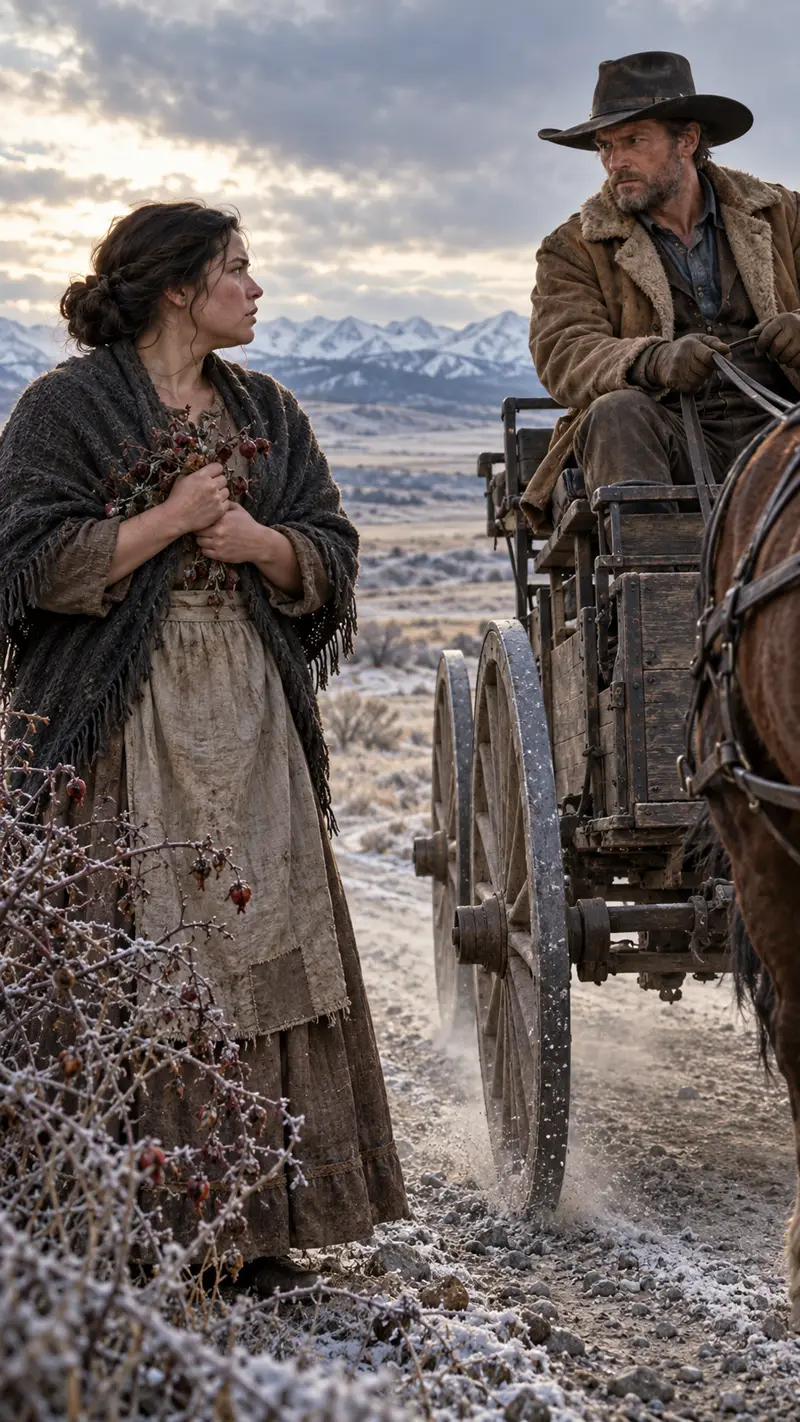
Snow buried the frontier homestead while the family's winter stores ran down to nothing. When the last of the hay stirred in the midnight dark, a forgotten debt of honor saved them all.
Elowen scraped the thick rime off the kitchen windowpane and watched the prairie disappear under yet another foot of mountain snow.
Inside the timber cabin, bitter morning drafts crept over the rough pine floor like invisible streams of icy water. On the scarred table sat the whole of their breakfast: a dark heel of bread, four dried berries, and a thin oat porridge.
Her youngest, Toby, pulled his small blanket tighter around his shoulders. “Can we eat now, Mama?” he whispered.
Elowen glanced at the spruce partition that divided the family's little living space from the animal stalls. “Not yet, little sparrow,” she said gently. She trimmed the lantern wick and headed for the frozen barn door.
For three generations on this high frontier ridge, an unwritten homestead law had carried pioneer families through the winter. The livestock ate first, before any settler touched a spoon, because their bodies gave off living heat that warmed the cabin walls. If the dairy cow and the goats died in the freeze, no amount of courage would bring the family through to spring.
In the low storage room the smell of dry prairie grass and winter dust hung thick. She measured out an armful of cured meadow hay for the cow, whose heavy flanks swayed with the coming calf. For the two milk goats she portioned brittle willow twigs and dried turnip tops put up in the August heat. A modest scatter of cracked corn went to the hens huddled against the draft whistling under the sill. Every dry stalk had cost hours of labor under a blistering sun, and every handful was treated like mountain silver.
Back in the kitchen, her husband Bram stood by the hearth with a dull bread knife. He cut the dark crust into four pieces and quietly pushed the two thickest toward Toby and Caleb. Neither boy asked about the uneven shares. Frontier children learned early that silence was the truest kind of family love.
Outside, the north wind kept hammering the log walls and piled snowdrifts halfway up the frost-crusted window.
Two more weeks slid by in that dim twilight, counted only by the scrape of the shovel and the thinning of the porridge. Every dawn repeated the same desperate rhythm: stir the banked coals, melt snow, tend the animals, ration what was left.
Then came the dreadful morning when Elowen plunged her wooden scoop into the flour sack and hit bare pine. She hurried to the storage room and tipped over the spare oat barrel, only to find dry hulls on the dusty bottom. With her heart racing, she raised the lantern and counted the bundles of prairie hay. Seven sheaves remained. Perhaps eight, if she spread them thin enough to keep the animals alive.
Bram appeared in the doorway, his breath puffing white in the frosty air as he watched her count.
“How long before it's gone?” he asked quietly, his tired eyes on her face.
“For us at the table, or for the stalls?” Her voice barely rose above the rattle of the roof.
“For the creatures.” He sighed heavily and looked toward the partition where the cow stood resting.
Losing her would mean losing the rich spring milk and the strong calf they needed to work the fields. If the goats died of the cold, nothing wholesome would remain to nourish Toby through the thaw. The animals were the living bridge between this desperate winter and the green promise of summer.
That evening the four of them sat in silence around a single candle and swallowed broth that tasted only of water and salt. From behind the stout spruce partition came comforting sounds: rustling straw, soft chewing, steady animal breath. That heat kept the killing cold from their beds, a living furnace against the blizzard.
Elowen lay awake under three heavy wool quilts, staring at the frosted rafters while the wind roared outside. A little past two in the morning, a bellow tore through the cabin, sharp with distress and pain.
She sat bolt upright in the dark and flung back the quilts before her feet found the freezing floor. A second groan rose from the stalls, and Bram was already striking a match to the tin lantern. Together they hurried through the low partition door, where the big brown cow trembled in the straw.
Elowen knelt beside her, pressing warm palms to the animal's neck and checking her swollen, straining sides. Dread dropped through her like a stone. The calf was coming three weeks too soon. Beyond the walls the storm screamed like an angry beast, sealing the valley road under drifts taller than horses.
“She can't birth this calf without strength, and our hay is nearly dust,” Bram murmured, his hands shaking with despair.
Before Elowen could answer, a shrill, terrified cry pierced the dark from the storage room.
“Mama, come quick!” It was Caleb, his young voice cracking with panic.
She sprang up from the straw, snatched the second lantern, and ran to where her eldest stood frozen. He was pressed against the timber wall, holding his lantern out on trembling arms and pointing at the hay. At the very bottom of the eight remaining sheaves, the dry yellow stems were quivering with violent, heavy tremors.
“Something's moving in there,” Caleb whispered, eyes wide, thin shoulders jammed against the logs.
As he spoke, one of the bundles lurched aside and thumped onto the dirt floor. A second rolled away, and then the whole lower half of the stack pitched forward.
Bram charged in with an oak wagon-tongue raised in both hands to shield his family from whatever lurked beneath. Elowen held her lantern high, and its golden light cut the shadows and showed a dark, bulky shape shifting among the stalks. They had stacked every armful of that grass themselves, months ago, over solid limestone bedrock. Nothing natural should have been able to burrow under their feed without a sound until tonight.
Then the stack gave way, and a trembling, frost-whitened hand reached out of the deep hollow in the yellow straw.
Caleb gasped and scrambled back to his father. Elowen dropped to her knees, her light falling on a weathered face. Under the fragrant grass lay an old man in frozen sheepskin, his beard stiff with white ice.
“Merciful heavens,” Bram whispered. The timber sank to his side as he recognized their neighbor.
It was Old Silas, the recluse who lived five miles up the gorge, cut off from everyone. Folks in the valley town had long called him a bitter miser because he never traded at the store. Now he lay shivering violently under their hay, his breath shallow and rattling like dry leaves in an autumn wind.
“Silas, can you hear me?” Elowen asked urgently, brushing frosted hay from his sunken cheeks and ice-crusted lashes. His eyelids fluttered open on pale blue eyes clouded with exhaustion. He tried to speak, but his cracked lips managed only a dry wheeze like leather dragged over stone.
Bram hooked his strong arms under the man's shoulders and eased him out of the hollow. In the lantern light they saw that Silas had not come through the kitchen door. High above the stack, the outer hay-chute door hung unlatched, jammed with a wall of hard-frozen snow. He must have tumbled through that upper opening in the gale and burrowed into the warm hay to survive.
But when Elowen looked into the cavity his body had left, her eyes widened. Wedged into the bottom corner against the limestone were two heavy canvas grain sacks tied with tarred twine. Beside them lay an oilcloth bundle holding dozens of sheaves of mountain alfalfa, still green and sweet-smelling.
“He didn't break into our barn to steal our food,” Bram said in amazement, laying his hand on the canvas.
Elowen untied the hemp knot on the nearest sack and sank her fingers into the heavy kernels of mountain barley. There was enough rich feed here to carry the cow, the goats, and the hens through six more weeks.
“Why would a lone man haul such wealth through a deadly mountain storm?” Bram wondered, looking down at their shivering neighbor.
Silas gave another weak moan, and his stiff fingers crept toward the inside pocket of his sheepskin coat. Elowen parted the stiff collar and drew out a small wooden box sealed against damp with yellow beeswax. Inside was a folded sheet of yellowed paper covered in a steady hand she had not seen since her youth. Tears filled her eyes the instant she knew it: the firm penmanship of her late father, gone these many years.
Bram leaned over her shoulder, holding the lantern steady so they could read the faint pencil lines. The note was dated twenty-five years back, to the terrible freeze that had wiped out livestock across the territory. It recorded a quiet gift of two young dairy heifers and three sacks of seed grain, sent to a ruined homesteader. Across the bottom her father had written: “No man owes me silver for mercy, but pass the bread forward when another family's chimney grows cold.”
For a quarter of a century Old Silas had carried that scrap of paper like an unpaid debt. He had come to seem cold and distant only because his fierce pride would never let him ask for charity. When the blizzards began to seal the valley, he had noticed from his ridge that the smoke from Elowen's chimney was growing faint. He guessed the young family was struggling with their stock, and the stubborn old man loaded his hand-sled to repay what he owed. But the gale caught him on the ridge trail and smashed the sled, and he had to haul the sacks the rest of the way on foot. Half-blind and freezing, he reached their barn roof and fell through the chute, collapsing into the hay before he could call out. For nearly two days he had drifted in a feverish sleep, kept alive only by the warmth of the stored hay.
Now, lying on the barn floor, Silas looked up at Elowen with eyes gone clear and full of quiet, lasting dignity.
“I swore to your father I'd repay his mercy before my days were done,” he whispered, his voice trembling.
“You nearly gave your life in a blizzard just to bring grain back to his daughter,” Elowen said, her eyes brimming.
“A pioneer's honor is the one thing the winter wind can't blow away.” He rested his hand on hers.
A long, agonized cry from the stall shattered the tender moment and dragged them back to the crisis. The laboring cow sagged against the spruce wall, her breathing shallow, her strength fast draining. Bram stepped into the stall, his face pale, and saw the problem: the calf was turned backward inside her. Neither he nor Elowen knew how to turn a reversed calf without killing it.
Silas struggled up onto his elbows, his frail body shaking, and pushed Bram's hands aside to peer through the stall timbers. “Warm well water and clean lard from the kitchen, quick,” he ordered, his voice sharp with authority. Caleb bolted for the kitchen door, eager to obey the old man who had brought hope into their barn.
Silas dragged himself across the straw into the stall, ignoring the stiffness in his frost-whitened fingers and weary joints. “Your father taught me how to turn a backward calf, in the Great Ice of seventy-four,” he murmured, touching the cow. Bram rubbed the old man's chilled hands with warm lard until the long fingers loosened and became supple again.
With infinite patience the veteran herder went to work, murmuring soothing prairie words to keep the mother calm.
With one firm, practiced motion learned over decades on the frontier, Silas turned the calf's small shoulders into place.
The weary cow let out a deep, shuddering breath, found the last of her strength, and pushed with all her will. Moments later a sturdy, dark-coated heifer slid into the fresh straw, sneezing and drawing her first breath. Elowen dropped to her knees beside the newborn and rubbed its flank hard with handfuls of the green alfalfa. The mother lifted her heavy head and licked her daughter, rumbling softly with relief. Silas leaned against the partition with a tired, radiant smile and closed his eyes as the weariness finally lifted.
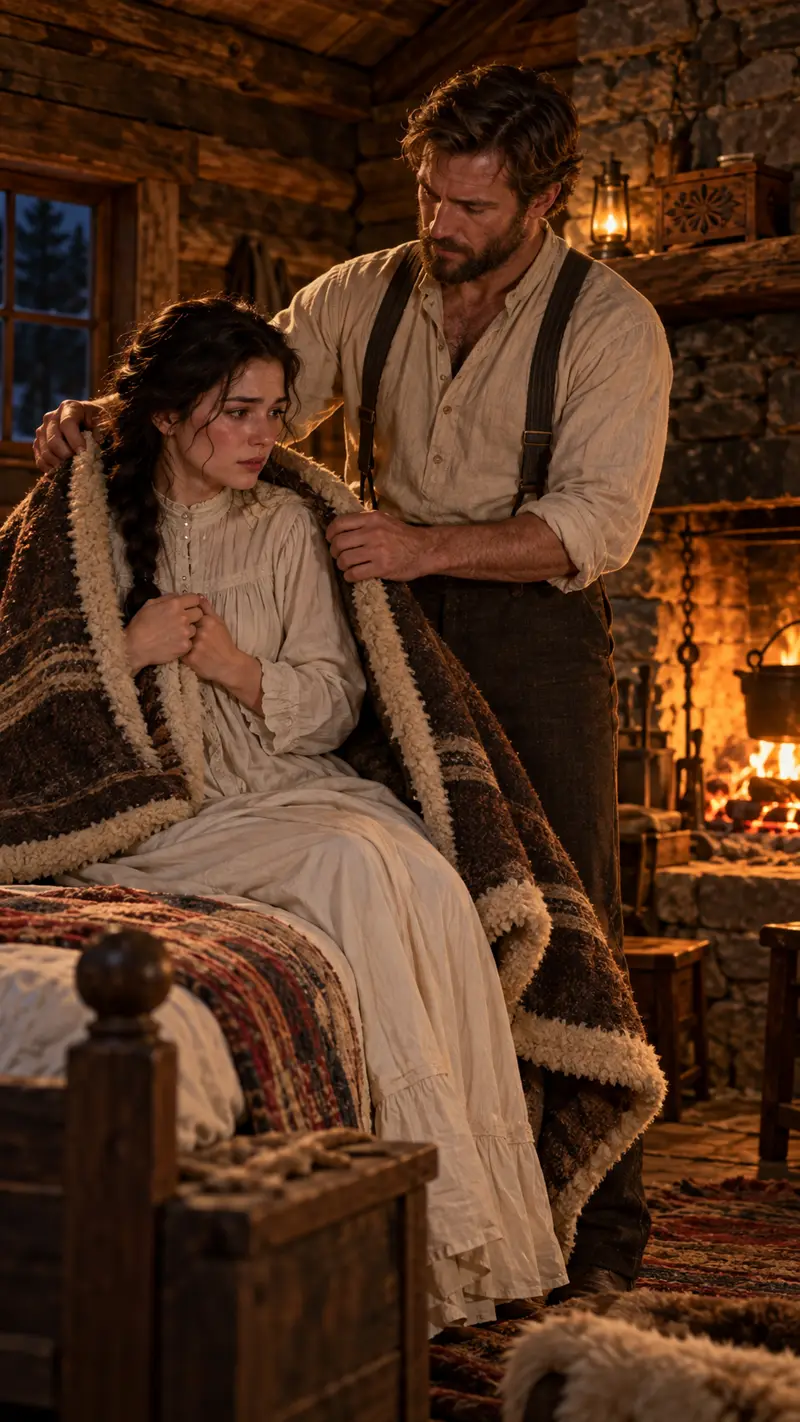
Bram stirred a generous measure of sweet barley into warm water in the cow's trough to bring back her vigor. Then he and Elowen, with gentle reverence, lifted the spent old neighbor and carried him into the kitchen. They settled him in the deep rocker by the blazing hearth and wrapped him in quilts while Toby brought hot tea.
For the first time in two bitter months, the cold shadow of starvation lifted from the little homestead. With two full sacks of barley and the rich mountain alfalfa, the animals would thrive until the spring pastures turned green. The heifer grew fat on her mother's milk, and the family's small herd would double in strength by autumn.
When the blizzard finally broke four days later and brilliant blue sky opened over the valley, Silas did not leave. There was plenty of room at the table, and the man who had lived in silence found a home. Each evening Toby and Caleb sat beside his rocking chair and listened wide-eyed to his tales of the early frontier trails. Elowen watched them from the stove. Her father's quiet kindness had crossed decades of silence to save her children.
The frontier could bring terrible hardship, but it could never erase the bonds forged by unselfish kindness. Mercy was never lost in the winter snows. It only waited under the drift for the hour of greatest need.
When spring at last crept up the high pass and melted the deep drifts into singing creeks, flowers filled the valley. Silas walked out into the warm sunshine beside Bram and pointed toward the timberline, where new pastures could be cleared. The old herder breathed the mountain air, his heart full and his debt repaid with a love no money could measure.
On the quiet frontier, kindness planted in secret always comes back through the longest winter as the richest harvest of all.