Sani stood rooted beside the timber door while the desert wind leaned hard on the cedar walls of the mountain cabin and set the logs creaking. The room was small and dim, and it smelled of smoke, pine and old leather.
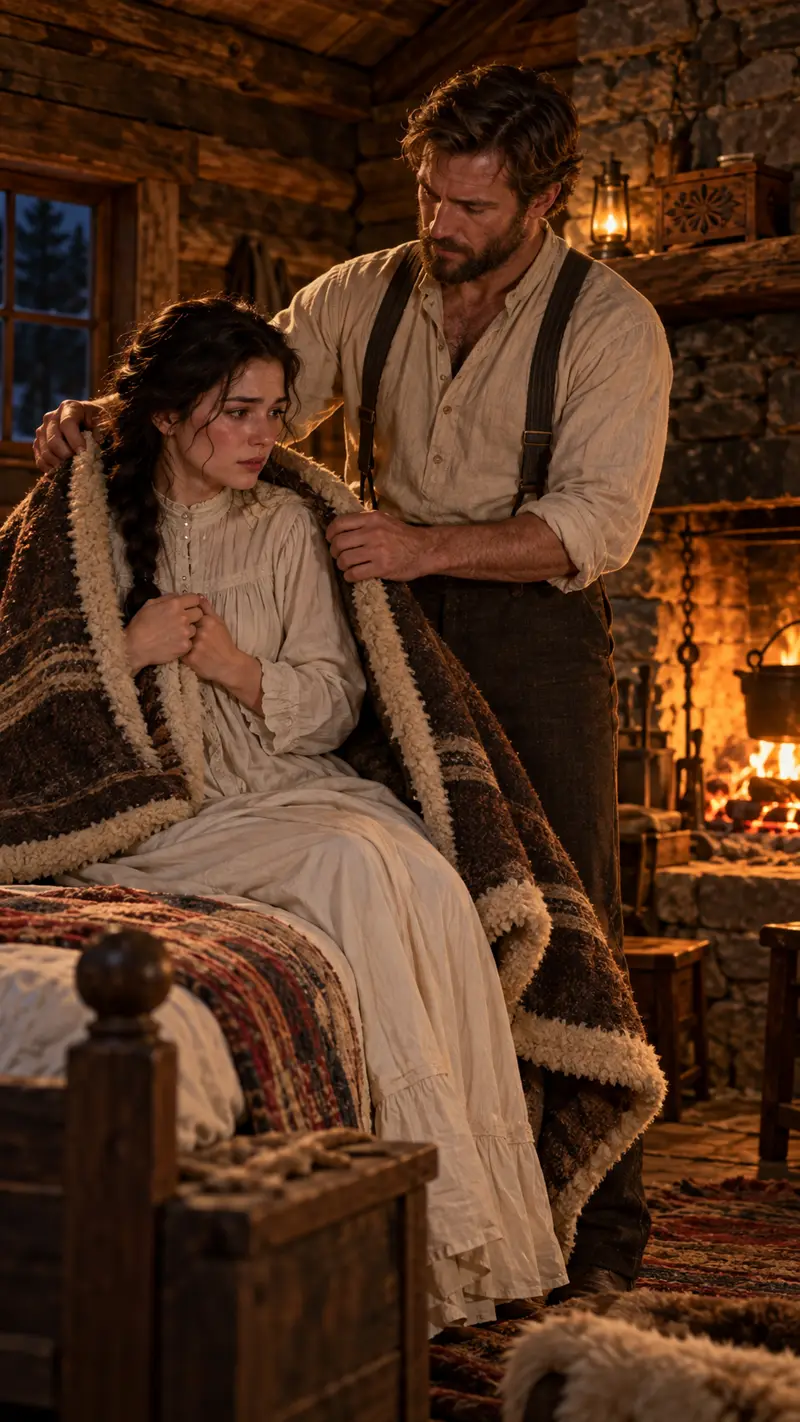
Caleb Rusk waited on the far side of the rough pine table with his weathered hands held open where she could see them. He had spread a wool blanket over the cot, and it was the only warm thing in a place where cold air crept up through the floorboards.
The government commissioners had left her at his gate only hours before, handled like an entry in a trade ledger. They called it an arrangement for frontier peace. No one had asked Sani whether she agreed to it.
Her dark eyes moved over every corner of the room. She was looking for the dangers she had spent her whole life learning to expect, and she found none she could name.
Caleb was fifty winters old, with silver threaded through his beard and shoulders bowed by the memory of a hard campaign. As a young Union scout he had watched treaties fall apart before the ink dried. He knew how a promise could be broken by men who talked about honor while they took everything within reach. Looking at the wary young woman now, he felt that old shame settle on him again.
He made no sudden move. He kept his boots planted on the dry stone hearth so she could see he would not come any closer.
"You may sleep there," he said, so low and gentle that the words barely crossed the room. "I'll stay by the fire until the sun clears the red ridges."
Sani did not stir. Her slender fingers gripped the frayed hem of her shawl as if it were a shield. She had heard what became of captive women in white settlements, how they were put to work as servants and lost their names.
When the rancher leaned forward to trim the smoking lamp wick, she pressed herself back against the cedar planks. Caleb stopped at once. His hand hung in the air a moment, then he drew it back and laid it on his knee.
He did not tell her there was nothing to fear, and he did not order her to calm down the way other men might have. He only bowed his gray head a little, as though he had read the fear in her steady gaze and meant to honor it.
The silence between them grew thick. Two worlds had been shoved into one drafty room, and neither had anything kind to say about the other.
Sani's eyes fell on the tin plate on the table. Roasted squash and warm cornbread sat on it, untouched. Her throat was dry from the long ride across the alkali flats, where the dust had coated every breath. Her moccasins were worn thin from walking beside the government wagons over sharp gravel. Her legs shook with weariness, yet her pride held her back as straight as an arrow shaft against the wall.
Then, in a voice no louder than a pine ember popping, she broke the stillness.
"It hurts," she whispered in halting English. Lamplight glittered in her eyes. "This is my first night away from my people."
Caleb stayed on his low wooden bench. He understood that even one innocent step might crack what little courage she had left. He looked at the floor and let his voice travel the distance the way a calm hand settles a skittish horse.
"It was a long, hard trail," he said, and he kept his palms open for her to watch.
He knew she was not talking about tired feet or mountain cold. She meant the tear in her world, the sudden cutting-off of a girl from everything she loved.
Without looking at her, he lifted the iron kettle and poured steaming water into an earthenware bowl. He crumbled a pinch of dried sage into it, and the clean, sharp steam drifted out into the chilly air. Beside the bowl he set a square of linen and a small jar of pine salve. Then he carried it all to the bench, walked back across the cabin, and sat down again by the fire.
"The water's clean," he said quietly. "The sage will ease your feet, if you want it."
Sani watched the steam curl upward. Her chest tightened, because she knew that wild scent of desert sage. For the first time that night it came to her that this gray-haired stranger was offering comfort and asking nothing back.
She waited several minutes, until he leaned against the stone chimney and shut his tired eyes in his watch. Then she moved like a mountain deer and took the warm bowl from the bench. She carried it behind the bed, where a canvas curtain hid her from view, and in that dim corner she washed the dust from her feet and hands. The warm water drew out the soreness of the trail, and the salve cooled her skin at once.
When she came out she had the blanket wrapped around her shoulders, and she sat on the edge of the mattress. Caleb had not shifted from his stool. His head rested against the chimney, just as he had promised. Across the room she could hear the slow, even breathing of a man who meant her no harm.
She drew her feet up under the quilt and listened to the wind howl around the corners of the cabin. In three weeks on the road with the escort she had never slept an hour without waking in fright. Yet here, with a silent stranger guarding the door, her heavy lids finally closed. She slept through the dark hours, soothed by the faint smell of cedar smoke and the sweet mountain air.
The first gray streaks reached the eastern hills, and the steady thunk of chopping woke her. Sani sat up with her senses sharp, but the cabin was empty and pleasantly warm. A pot of cornmeal porridge simmered on the iron stove and filled the room with the smell of sweet grain. Beside it sat a small crock of wild blackberry preserves and a clean tin cup of spring water. The front door latch hung loose on its peg. She was not a prisoner.
She went to the little glass window and parted the muslin curtain. Across the frosty yard, fifty yards off, Caleb was splitting pine logs with long, strong strokes of his axe. He wore only a faded wool shirt in the morning cold, and his breath rose in white puffs. Every piece he split went into a tidy stack against the shed wall, to keep the hearth fed when the snow came.
Sani ate the porridge slowly. It tasted of patience and care, not of charity or pity. When she finished she washed the plate with boiling water from the kettle and dried it. She would not be an idle burden, no matter how she had come to his door. She found the switchgrass broom and swept the hearthstones, firmly and without hurry.
Beneath the cedar bench the broom struck something solid. She knelt on the flagstones, reached into the recess, and drew out an old chest of aromatic juniper. The lid was not latched. Inside, under folds of clean calico, lay a few things wrapped with great care.
She lifted the top cloth, and her breath caught. It was a coiled willow basket, worked in the geometric fire patterns known only to her mother's clan. Next to it lay a polished silver hair comb and a paper marked with the faded seal of the territorial court. Her trembling fingertips traced the weave of the willow stems, and she knew the hand that had made it. It was her own grandmother's.
Cold shock ran through her. How did a white rancher come to hold treasures from her lost home?
Before she could study the paper, carriage horses clattered into the yard. She shut the chest, shoved it back into its hollow, and crept to the window.
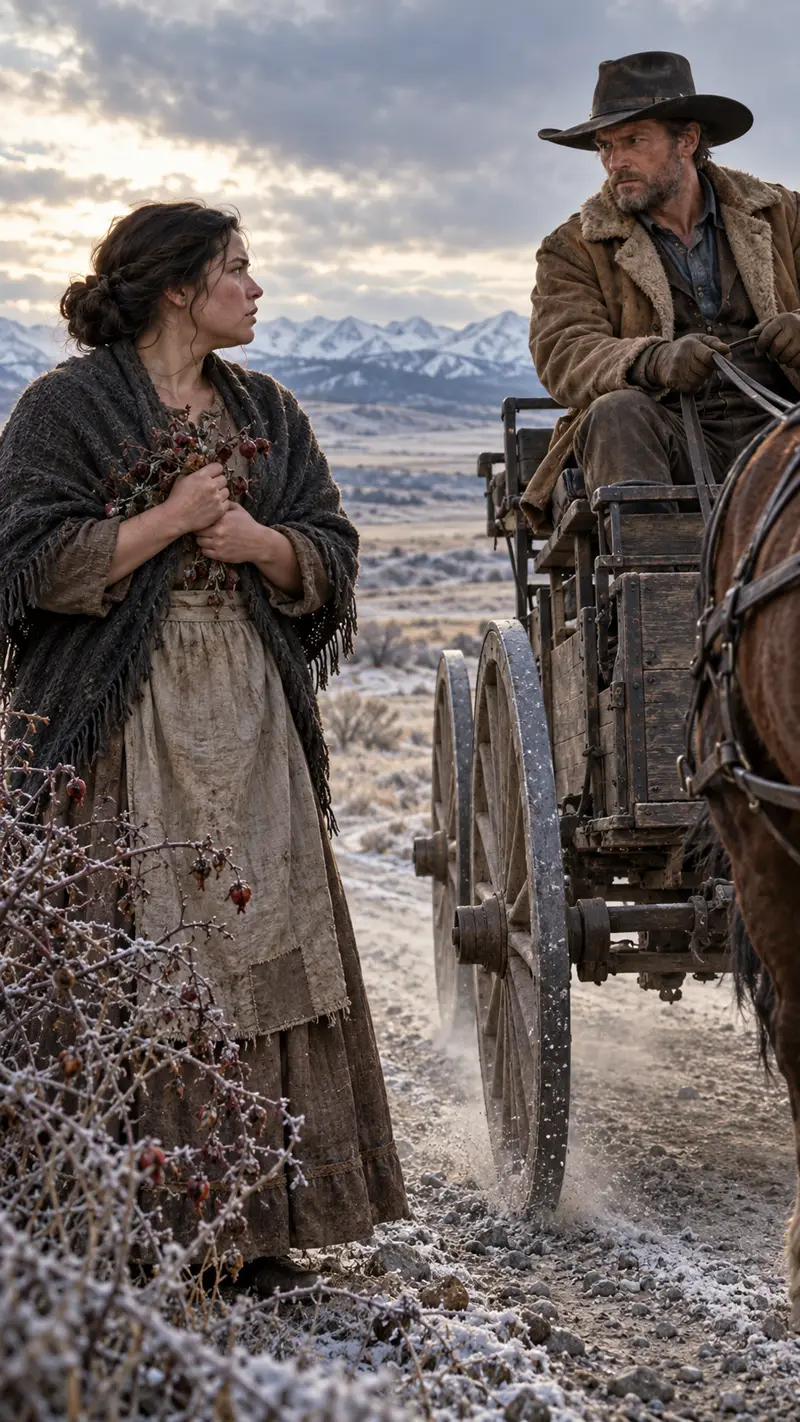
A black buckboard had stopped at the hitching rail, and two men in heavy wool coats sat in it. One was Deputy Miller, known across the territory for doing the bidding of wealthy land speculators. The other was Henderson, the prosperous merchant who owned the general store and ran the valley's new cattle syndicate.
Through the glass she saw Caleb set down his axe and walk slowly toward them. He wiped his forehead on his canvas sleeve and halted several paces short of the carriage wheels.
"Business out here this early, Henderson?" he asked evenly.
Henderson tugged at his coat and looked past the rancher toward the cabin door, a thin sneer on his lips. "We've come to inspect the arrangement the peace council gave you, Rusk," he said with cold authority. "The town council approved this marriage on the condition that her presence would secure the water rights along the canyon. Word in town is that you're keeping her hidden and won't file the joint land deed."
Deputy Miller leaned out from the bench and tapped the rail with a gloved finger. "If this is a sham, Caleb, the council will rescind your homestead grant before the weekend," he warned. "They'll call the girl an uncooperative ward of the territory and send her to the military garrison down south."
Sani understood enough of their sharp words to know that the shelter she had barely found was in sudden danger. The southern garrison would strip away what little freedom and dignity she had won back.
Caleb took one step toward the carriage, and his tall frame seemed to harden into stone.
"The lady in my house is my guest under the laws of this territory," he said. "She isn't property to be inspected. As for the canyon spring, that water belongs to the people who were born beside it long before any of us."
Henderson scoffed, and his face darkened as he saw that the widowed rancher would not be scared. "You think fine talk will defy the town council, old man? The magistrate sits at noon in the records office. You'll show signed proof there, or you'll hand over the deed."
He did not wait for an answer. He snapped the reins and wheeled the buckboard around, flinging up dry winter gravel. Caleb watched the dust settle along the wagon road, his jaw set and his thoughts troubled.
When he turned toward the porch, Sani stood in the sunlight watching him steadily. She came down the cedar steps with the juniper chest in her arms and set it on the porch rail.
"You know my people," she said. Her voice was stronger and clearer than it had been the night before.
Caleb stopped at the foot of the steps and looked at the willow basket with deep regret. "Ten winters ago, in the bad campaign near the river, I was scouting for the army," he admitted softly. "I came on an abandoned camp after the soldiers had swept through, and I helped your grandmother get to safety in the hills. She gave me that basket. She told me to keep her family's claim alive until the rightful daughter came home."
Tears rose in Sani's eyes as the pieces of a forgotten family story fell into place. Her grandmother had spoken of an honorable scout who defied army orders to protect the clan's sacred records.
Caleb opened the leather folder inside the chest and showed her the original territorial parchment, stamped with her grandmother's clan marks. It was no settlers' marriage certificate. It was a perpetual land grant, recognizing her family's sovereignty over the valley for all time.
"Henderson doesn't want peace," Caleb said, meeting her eyes with plain respect. "He wanted me to marry you under settler law so he could claim your inheritance through a false tax lien. I agreed to bring you here to keep you safe until we could carry this deed to the federal judge."
Sani looked at the weathered hands that had warmed water and set out food without asking a thing in return. The suspicion that had caged her spirit melted in the warm light of the Arizona morning.
"We go together," she said firmly. She took the parchment in her own steady hands and held it to her chest.
Caleb nodded with quiet pride. He led two saddle horses from the corral and pulled their girths tight, and they rode side by side across the red canyon plateau. The noon bells were ringing as they entered the dusty settlement.
A crowd of curious settlers had gathered outside the records office, murmuring as the strange pair dismounted. Henderson stood on the boardwalk beside Magistrate Cole, a sheaf of fresh eviction papers in his hand and triumph all over his face.
"You're too late, Rusk!" he crowed for the crowd's benefit. "The council has declared your homestead void, and this Apache woman has no standing in this court."
Sani stepped onto the pine boardwalk with her head high, her grandmother's silver comb shining in her dark hair. She laid the parchment on the magistrate's desk, and her voice rang clear over the hushed crowd.
"This land does not belong to Henderson," she said. "It does not belong to Caleb Rusk. It belongs to my people."
Magistrate Cole adjusted his spectacles and studied the golden territorial seal and the governor's signature, his astonishment growing.
"This document predates the town charter by eight years," he announced, turning to Henderson's pale face. "The whole canyon watershed is held in federal trust for this woman's clan. No council may ever touch it."
A stunned hush fell over the settlers. Henderson lowered his useless papers, and his greedy scheme lay in ruins in front of everyone. Caleb did not gloat. He only stepped to Sani's side to honor her victory before the town.
They rode home toward the mountain cabin under a golden dusk. Sani glanced at the steady, quiet rancher beside her.
"Last night I told you it was my first night," she said, and she gave him a rare, warm smile. "My grandmother taught me that the first night among strangers shows whether a man carries wolves or honor in his heart."
The deep lines of his weathered face eased under the twilight sky. "Then tonight is your first night as an equal on your own ancestral ground," he answered quietly.
The stars of the wide Arizona sky came out one by one. The cabin door stood open to the mountain breeze, and there was no fear left inside.