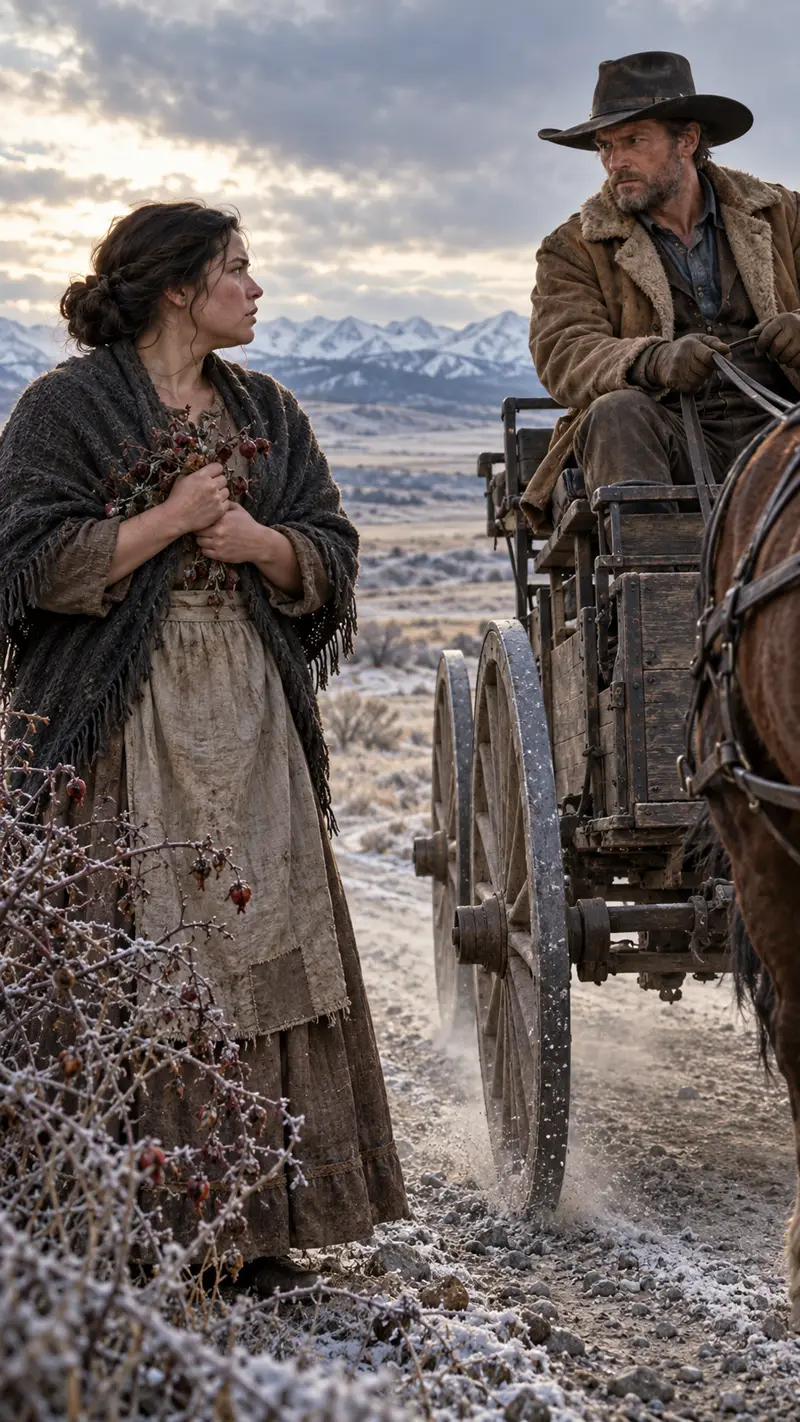
For seven long years the proud Apache woman had sent away every suitor who rode into the Gila Valley with silver in his pocket and empty promises on his tongue. She never guessed that the quiet widower sitting thirty yards off in the river dust carried the missing key to her family's sacred land.
Late in the afternoon the sun hung over the Gila cottonwoods like hammered copper and laid long shadows across the shallow water.
Nalka sat on the flat river stones with her knees pulled in, watching ripples split around her bare ankles. For seven years she had listened to men offer silver, fine horses, and promises that meant nothing in exchange for her hand. Every well-off cattleman and ambitious teamster who crossed the territory seemed to think an unmarried woman was a prize waiting to be claimed.
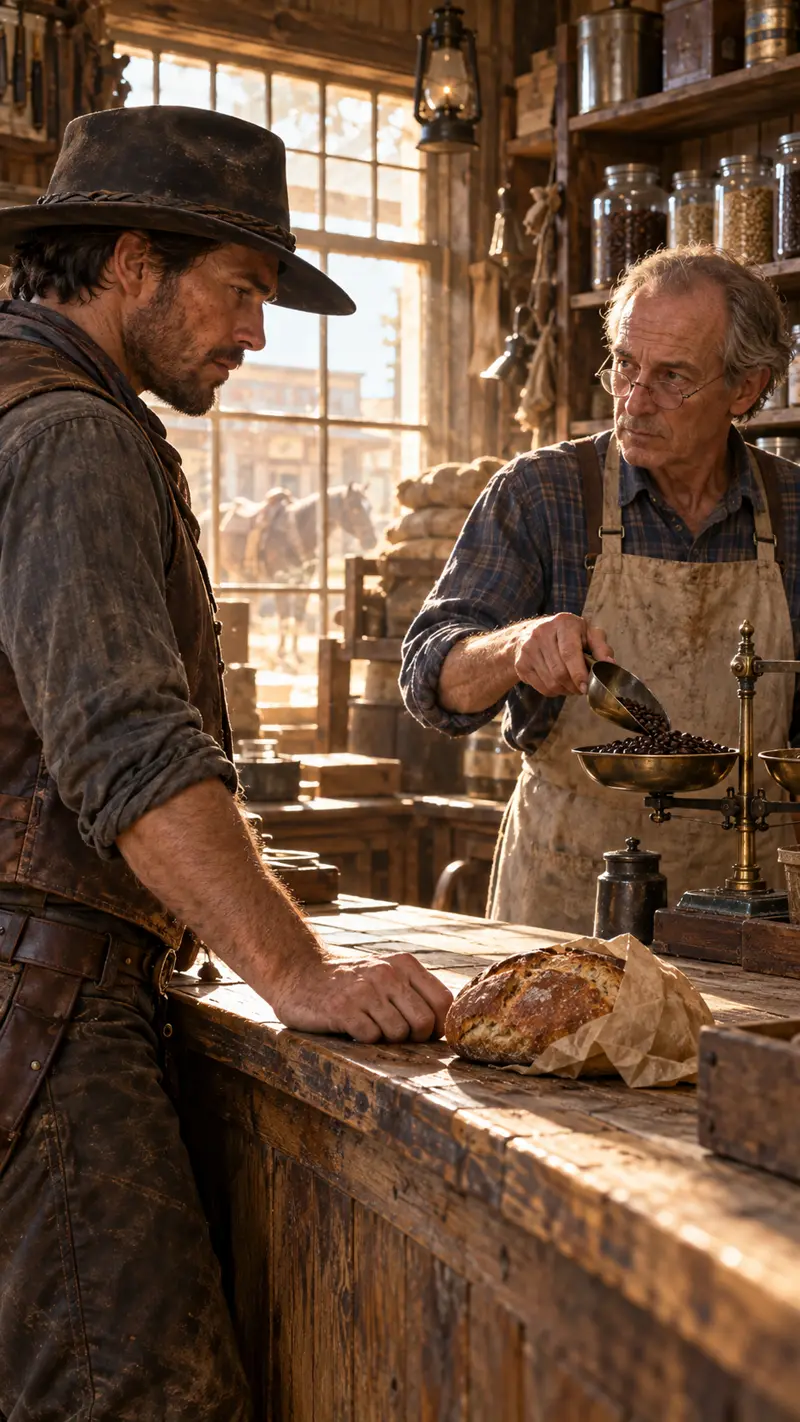
The stranger was different. He had graying temples and trail dust on his collar, and he had not reached for her at all. He had only rested his hands on his battered felt hat, thirty yards away, and asked whether the bank had room for one more.
Elias Reddick said nothing more until twilight turned the red canyon walls to cool lavender. Then his limping mare nudged his shoulder, and he asked only about a willow bark poultice for swollen joints. Nalka mixed the crushed leaves with resin without a word and passed the bundle across the open space between them. He took it with a bowed head, pressed a silver coin into the moss, and rode off without once looking back.
She left the coin on its rock until the moon came up, troubled by how little greed there was in him. A man who asked for nothing was a dangerous thing. His quiet modesty gave her no easy reason to send him away.
What she could not know was that eighty miles to the south, the shadow of a wealthy cattle baron was already stretching toward her peaceful valley.
Elias reached his homestead at Box Canyon as the morning wind began to rustle the dry grama grass. His cabin stood on a poor stretch of land, built of hand-hewn cedar and river rock, with one cold spring bubbling out of the ground. Three years had passed since the fever took his wife, Martha, while he was driving cattle through the northern chaparral. He still kept her porcelain teacup on the shelf beside his Bible and lived in the hush of an empty house.
He had not even unsaddled the mare when the sharp ring of iron horseshoes on stone rolled down the narrow draw like thunder.
Harlan Vane rode into the yard on a magnificent black stallion, two silent riders with polished leather holsters at his back. The cattle baron wore a tailored wool coat, and a gold-headed cane rested against his hand-tooled stirrup.
"I've come for your answer, Reddick," he said without dismounting. "My clerk has the bank draft."
Elias wiped alkali dust from his forehead with his sleeve and met the rancher's pale, cold eyes. "The spring feeds my stock, Mr. Vane. I gave you my final answer last Tuesday."
Vane leaned over his saddle horn, his mouth bending into a thin smile that never reached his cheekbones. "You're holding the only gate between my valley pastures and seven thousand acres of rich bottomland the legislature will clear. One stubborn settler can't stop progress, Elias. Especially when the original territorial boundary survey from sixty-eight carries your own signature."
That forgotten year hit Elias like ice water and drained the color from his weathered face.
In the autumn of 1868 he had been a nineteen-year-old clerk, hauling brass measuring rods for the boundary commission. He thought he was serving the law, recording the springs and canyon markers that promised the Apache families a permanent home. Only later did he learn that Vane's late father had rewritten the notes and turned protected land into unassigned public range. Elias was too young, and too afraid of a military prison, to speak out when the altered maps were filed in Tucson.
But he had committed one small act of rebellion before slipping out of the surveyors' mountain camp for a life alone. He had sealed the true parchment notebook, the one with the Apache headmen's marks, in oilcloth and hidden it beneath the northern monument. For fifteen long winters that memory had glowed in his chest like an ember that refused to die.
Vane turned the stallion sideways. "The old survey gets certified by the district judge in town on Friday morning. Once the decree is signed, the constables will clear every lodge off the river bluffs, and your homestead will go with them."
Elias did not move as the three riders wheeled and galloped back along the winding trail to the southern settlement. He looked at his calloused palms and knew that running from his old cowardice had only brought the storm to his door. If he kept silent now, the quiet woman by the willow creek would pay for his youthful failure.
The sun had barely cleared the jagged eastern peaks when he rode his healed buckskin mare back to the shallows.
Nalka knelt by the water with a willow basket, gathering the dark roots her grandmother used to dry for winter ailments. She heard hooves clink on the river gravel and rose without hurry or alarm. Her dark eyes took in his weary posture and noted he carried no saddlebags and none of the heavy rifles other travelers wore.
"The buckskin's leg has cooled," she said, her voice low and even above the murmur of the stream.
Elias swung down, took off his hat, and stayed twenty paces away in the shade of a cottonwood. "Your medicine worked better than anything the army surgeon ever mixed. I owe you honest thanks."
Nalka shifted the woven strap of her basket and studied the deep creases around his eyes, the kind lonely nights leave. "You didn't ride sixty miles in this heat just to tell an Apache woman her grandmother's poultice cured a tendon."
Elias let out a slow, ragged breath carrying fifteen years of dust and hidden sorrow. "Harlan Vane is filing papers at the district court in San Carlos to seize this whole valley before the week is out."
She did not flinch, though her fingers tightened on the wicker rim until her knuckles paled. "Many men have brought papers with red seals to our valley, Elias. The river is still here, and so are our people."
"These papers are different." He stepped forward two paces, then stopped himself out of respect for her boundary. "They carry the stamp of the 1868 federal survey, and my own name is written in the ledger."
The morning wind lifted strands of raven hair across her high cheekbones as she gazed at him. "You were one of the blue-coated men who measured our sacred canyons with pins and iron stakes when I was small."
"I was nineteen and ignorant, following a corrupt officer who took bribes from Vane's father." He looked down at the river stones between them, unable to bear the calm, piercing judgment in her eyes. "When I saw them alter the maps to erase your grandfather's village, I had neither the rank nor the courage to stop it."
Nalka walked to the water's edge and let the clear mountain runoff swirl over the tops of her moccasins. "My grandfather said the men with measuring stakes stole the earth without lifting one shovelful of dirt."
"He was right," Elias said, his voice cracking with remorse. "That shame has followed me into every valley in the West."
"Then why bring this trouble to my water today, when you could have stayed safe on your own creek?"
"Because I never burned the original field ledger, though the officer ordered me to throw the records in the stove. The true map is still sitting in the stone cairn at Eagle Pass, with your grandfather's mark and the government seal on it."
A deep silence settled over the riverbank. Only a lone hawk called as it circled the red cliffs.
Nalka set down her basket and looked past him toward the rugged ridge guarding the northern approaches to the reservation. "The elders spoke of a stone marker near the pass that the soldiers raised before they broke camp and left in a hurry. We must reach that cairn before Vane's outriders find it. Once the parchment is destroyed, the court will accept his boundary."
Without another word she walked to a small corral behind the cottonwoods and led out a lean, sure-footed paint pony. She rode with no heavy saddle, sitting straight and graceful on a folded wool blanket with the easy balance of a mountain-born rider.
Together they climbed the winding goat paths out of the valley basin toward the windswept heights of Eagle Pass. The afternoon sun beat down on the rocky switchbacks and baked the scent of wild sage and juniper into the thin air. Elias kept his horse a little behind hers, marveling at her quiet certainty. She never asked about his lost wife, his lonely homestead, or the years he had lived like a ghost. Yet in the spaces between the rhythm of their horses' steps, an unspoken understanding began to take root between two lonely souls. She had spent her womanhood guarding her family from arrogant suitors, and he had spent his manhood hiding from his failure. By the time the jagged outline of Eagle Pass rose against the darkening sky, their shared silence felt like real shelter.
The cairn stood on a high, bare plateau where the evening wind whistled through deep cracks in the granite boulders. It was a cone of heavy river stones, weathered by fifteen winters of mountain frost and violent summer flash floods. Elias knelt at its base and used his bare hands to pull away thorny cactus and sharp shale. Nalka stood watch at the lip of the ridge, her gaze sweeping the dusty southern road to San Carlos.
"Dust, four miles down the valley road," she warned, pointing to a thin yellow cloud drifting over the mesquite.
Elias worked faster and pried loose a flat slab of red sandstone that sealed the hollow inside of the monument. Beneath it lay a rectangular tin dispatch box wrapped in oilcloth, its edges sealed with dried beeswax. His hands shook a little as he cracked the brittle wax with his pocketknife and lifted the hinged lid.
Inside was the leather-bound surveyor's journal, its yellowed sheepskin pages spared from damp by the dry mountain air. Nalka knelt beside him on the cold rock, her dark braid falling over her shoulder as she bent over the ledger. On the last page, below the precise ink lines of the territorial surveyor, was a hand-drawn pictogram of a rising sun.
"That is my grandfather's mark," she said. "He drew it with the eagle-quill pen the government agent gave him at the treaty council."
Elias traced the faded black ink with his thumb and felt the weight that had crushed his spirit begin to ease.
At the San Carlos trading post, the territorial court commissioner had set up his temporary desk on the wide cedar veranda. Harlan Vane stood beside a walnut table piled with legal folios, surrounded by local stockmen and an armed territorial marshal. Thirty paces back, under the mesquite trees, a crowd of Apache families from the river bottom waited, silent and watchful and anxious.
"The law is unequivocal, Commissioner," Vane declared, tapping a crisp parchment map with his polished brass magnifying glass. "This certified transcript from 1868 shows the tribal boundary ending at the western ridge of Box Canyon. That means the whole lower valley basin reverts to open public domain, subject to my registered grazing preemption claims."
The aging commissioner had not yet dipped his steel pen when approaching hooves scattered the corral chickens.
Elias Reddick and Nalka dismounted together at the hitching rail, their clothes caked with mountain dust, their faces set. The cattlemen shifted on the boardwalk and muttered in surprise as the reclusive Apache woman walked straight toward the magistrate's desk.
"Hold your pen, Commissioner," Elias said, calm and clear enough to carry across the crowd, "before you sign away our land."
Vane's eyes narrowed to slits of cold fury, and his cane struck the cedar planks hard. "This man is a broken-down squatter with no standing in this court, and the woman is an agency ward."
"I was the clerk who carried the survey equipment on that expedition," Elias said, "and this tin box holds the only authentic record." He set the dispatch box on the commissioner's ledger and threw back the lid so the parchment journal showed.
The magistrate, an elderly judge named Albright who remembered the early border commissions, adjusted his spectacles and turned the fragile leaves. He examined the copper seal pressed into the wax and compared the surveyor's original cursive entries with Vane's registered duplicate.
"The map Mr. Vane has presented," Judge Albright murmured in astonishment, "is a fraud, drawn in Tucson after the survey disbanded. These original field notes establish that the eastern boundary takes in all the bottomlands three leagues beyond the river bends."
A murmur of relief rippled through the Apache families, while Vane's hired riders slowly backed away from their employer. Vane slammed his gold-headed cane against the table leg. "An outrage, cooked up by squatters and liars! You'd take the word of an Apache woman and a drifting laborer over thirty years of respected ranching capital?"
Nalka stepped past Elias and stood tall before the magistrate, with the same dignity that had humbled a hundred arrogant suitors. "My grandfather gave his word to this territory on this very parchment, and our people have kept that peace unbroken. The only man in this valley who broke his word was your father, Mr. Vane, and today the earth has given back the truth."
Judge Albright pressed the territorial court's iron seal onto the original journal and swept Vane's fraudulent papers right off the desk. "The tribal patent is affirmed in perpetuity, and if you or your riders cross the river boundary, the marshal will arrest you."
Vane climbed onto his black stallion without a word and spurred through the dust while the townspeople watched him go. The Apache elders came to Nalka with soft murmurs of honor, touching her shoulders in thanks before turning toward their trail home.
Elias stood quietly by the hitching rail, ready to tighten the cinch on his buckskin and slip away to his cabin. He had delivered the truth and repaid his fifteen-year debt to the valley, and he expected nothing more from the world.
But before he could set his boot in the stirrup, a light, firm hand came to rest on the worn saddle leather. He turned and found Nalka looking up at him, her dark eyes warm with a feeling no suitor had ever seen there.
"For seven years," she said softly, "wealthy men have come with horses and silver and gold, trying to persuade me that I needed them. Not one ever offered to protect the dignity of my people at the cost of facing his own deepest regret."
A knot in Elias's throat came loose, and for the first time since Martha's death, his chest felt warm again. "I was only trying to right a wrong that should never have happened, Nalka."
She stepped closer and closed the distance between them that had stood like an uncrossable river when they first met on the bank. "The sun will be setting over the cottonwoods in an hour, Elias, and there is still cool shade under the willows."
She smiled for the first time, her voice steady and full of grace. "Would it be all right if you sat with me?"