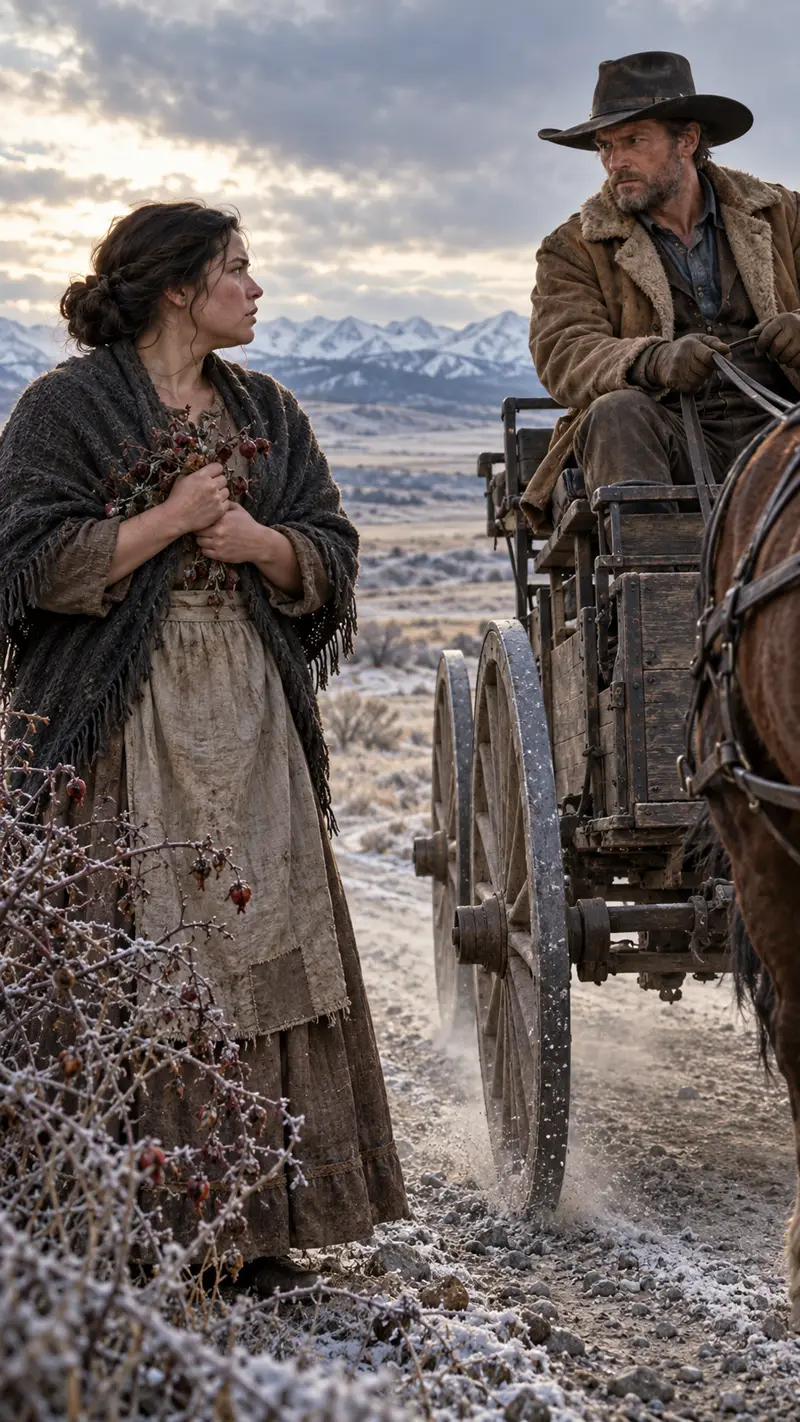
A quiet stranger walked into a frontier cookhouse looking for shelter, and his coming changed the fate of an overlooked woman for good. When winter threatened to take everything she owned, the truth in his canvas sack gave her back her rightful dignity in front of the whole valley.
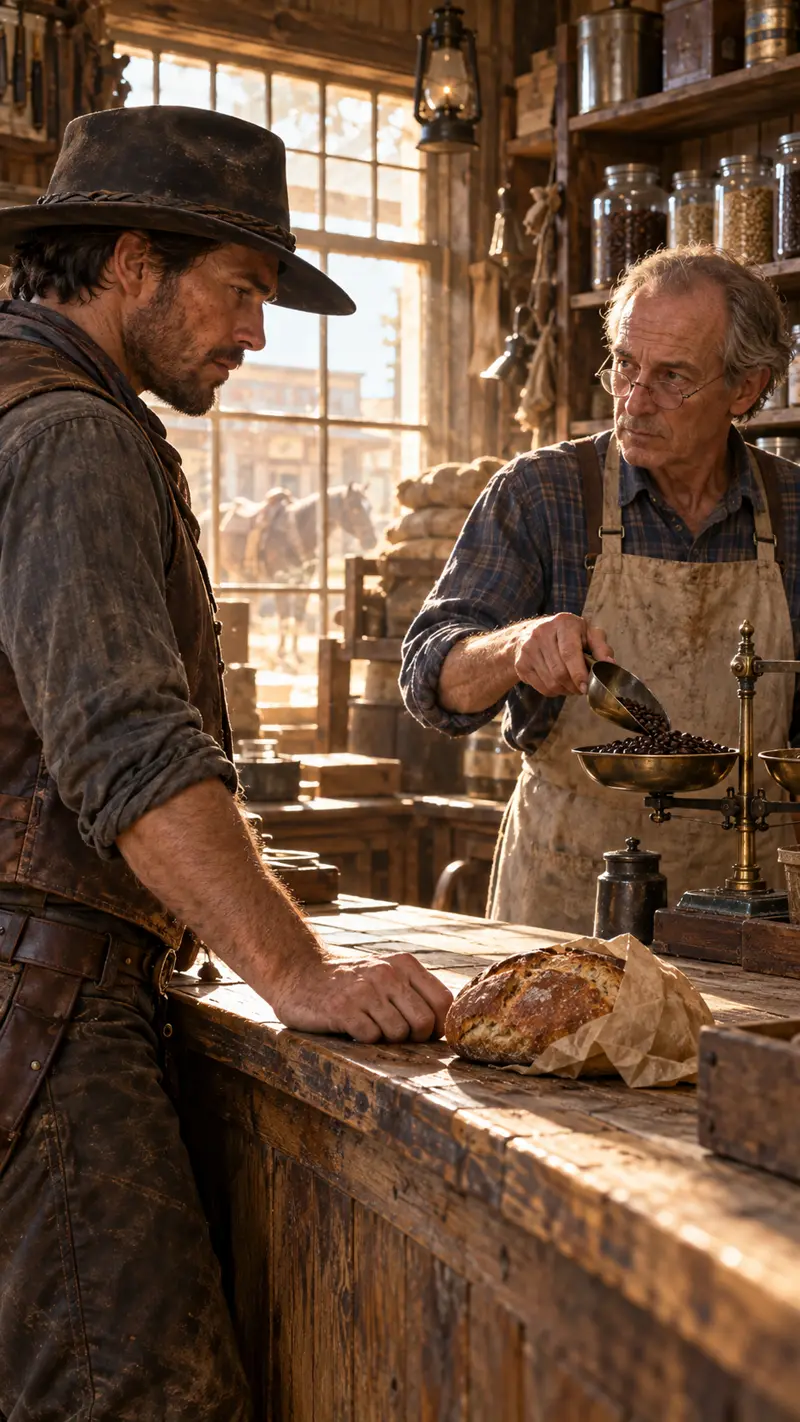
Silas Harlan neither raised his voice nor reached for a weapon as he moved between the crowded tables of the Copper Pot cookhouse.
His tall frame swallowed the yellow lantern light and threw a huge shadow over the miner who was still leaning through the service window. Grover Vance choked off his next crude laugh. The sneer froze on his face as he felt the stranger loom behind his shoulder.
Silas laid one big, frost-roughened hand flat on the pine counter. The wood creaked softly under the calm weight of it.
“The lady's stood at a roaring hearth since dawn to feed this town,” he said in a low, gravelly rumble that carried through the room, “and you'll speak to her with a civil tongue. Pay for your meal, take your seat like a man, and give Mistress Delia the respect she's owed.”
This mountain stranger had stepped forward to defend her honor, and he met her gaze with an open, plain respect that she had never known in all her life.
Silas did not go back to his chair. He unbuttoned the cuffs of his flannel shirt and walked straight through the swinging kitchen gate. Delia stared at him, unable to believe it, as the giant eased the iron pot of scalding beans out of her trembling, heat-reddened hands.
“You've got fifty hungry bellies to fill tonight, Miss Delia,” he murmured, “and two hands can't hold back that tide.”
Without another word he stacked twenty heavy earthenware bowls and began ladling out steaming portions of beef stew, quick and easy as if he had done it for years.
“Nobody in this valley ever spoke up for me against those men, Silas,” Delia whispered, her voice unsteady in the dim room.
He took the warm plate she handed him, his calloused thumb brushing hers. “A woman who spends her youth keeping other people alive deserves to be shielded from fools.”
For the next two weeks the bitter mountain winter shut the high passes of the Colorado territory under five feet of hard, glittering snow. Silas was up before the first rooster, splitting cords of seasoned pine and red oak until the woodpile climbed higher than the cookhouse roof. Between her shifts at the iron range, Delia caught herself watching the quiet grace with which he moved through her small world. He never asked for wages and never complained of the freezing wind. Every morning, when she came in, a fresh pot of coffee was already boiling.
For the first time since her parents died, Delia woke up eager for the daylight, no longer weighed down by the loneliness of her routine. Yet she couldn't miss the moments when Silas stood at the frost-patterned window with his jaw set, studying the road. At sundown he would take a heavy silver pocket watch from his vest and check its steady ticking with a look of grave, unreadable sorrow. She longed to ask what burden had brought him down from the high ridges into Red Dog. She never dared to pry.
The fragile peace broke on a gray Tuesday afternoon, when the brass latch of the front door clicked open with slow, deliberate arrogance.
Nathan Calloway stepped in, shook fresh snow off his tailored wool duster, and pushed his gold-rimmed spectacles up with slender, ink-stained fingers. As chief land assayer and creditor for the Red Dog Mining Syndicate, he held the mortgages on half the businesses in the district.
“Delia, my dear woman,” he said with a thin smile, “I trust your kitchen is warm. I've brought news that will chill your spirit.”
Delia wiped her flour-dusted hands on her canvas apron. An icy knot pulled tight in her stomach as she stepped behind the counter. “If you've come for supper, the beef stew will be ready at five, Mr. Calloway,” she answered, working to keep her voice level.
“I'm afraid your cooking days in this valley are coming to an abrupt end.” He laid a legal folio on the wood. The ten-year land lease granted to her late father, Arthur Norwood, he explained, had expired at the turn of the year. On top of that, the company books showed an unrecorded promissory note for five hundred dollars, supposedly borrowed by Arthur before the old shaft collapsed five winters ago. “Unless you produce five hundred dollars in gold eagles within forty-eight hours, this building and its lots go to the syndicate,” he finished smoothly.
The breath left Delia's lungs. The kitchen walls seemed to close in on the only home she had ever known.
“My father paid every copper of his timber debts before he died,” she pleaded, “and you know it as well as anyone in Red Dog.”
“A lovely sentiment, Miss Norwood. But the town records office burned three summers ago, and my ledger is the only legal authority left.” Calloway sneered. “You have until Thursday noon to produce the coin or vacate, or the sheriff will carry your stoves out into the snowbank.”
The door shut behind him. The silence that came back was heavier and colder than the blizzard howling in the rafters.
Silas had been standing motionless at the kitchen entry, watching it all from the shadows with a dark brow and clenched fists.
That night, after the supper crowd thinned and the lanterns went out, Delia sat alone at the prep table with her tin strongbox open. She counted her life savings three times: every frayed greenback, silver dollar, and copper piece scraped together over seven exhausting years. It came to barely eighty-four dollars, a pitiful sliver of what the corrupt syndicate demanded. She buried her face in her calloused hands, and the plain fact of her helplessness finally broke the proud resolve she had held for years.
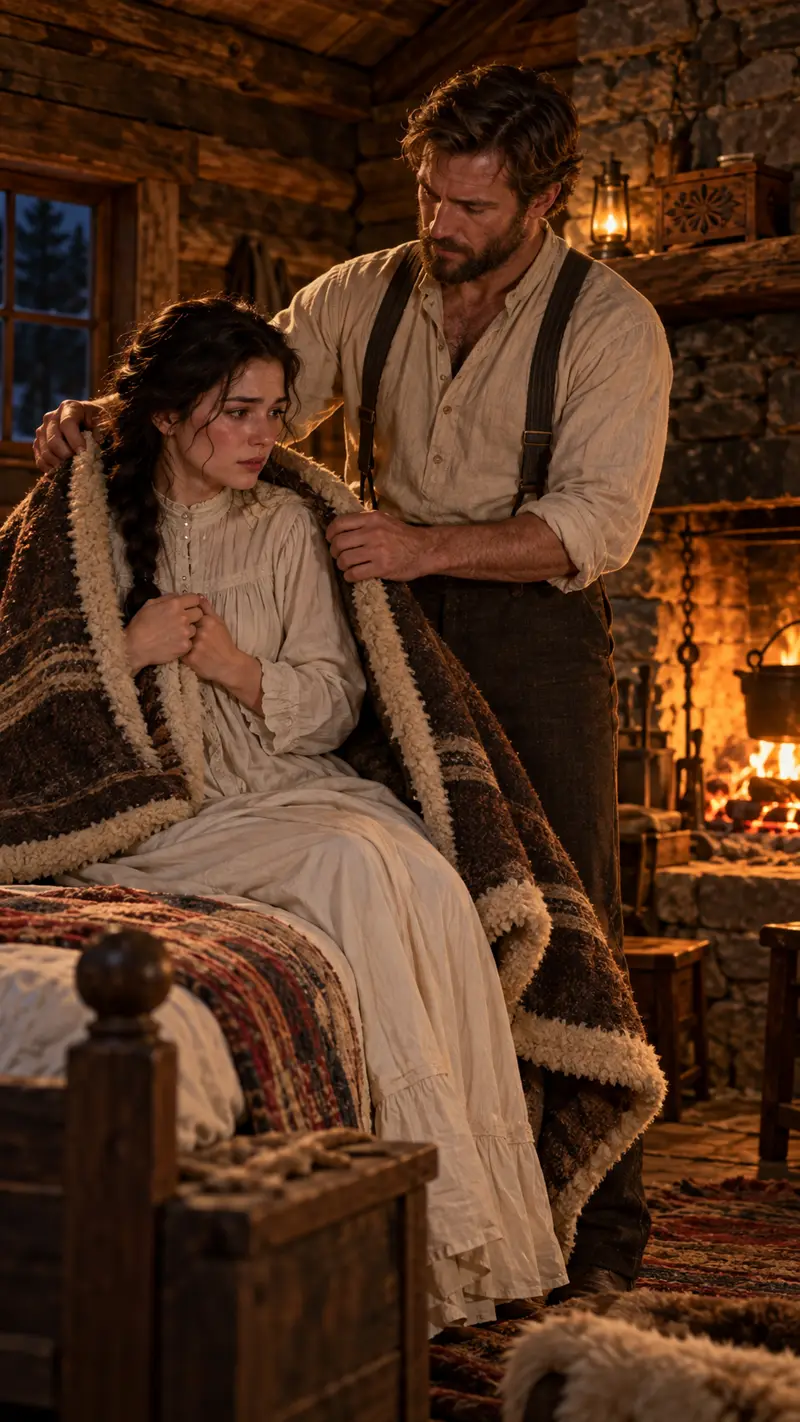
Soft footsteps crossed the pine planks. Silas set a steaming tin cup of roasted chicory and honey beside her elbow.
“Weep if you need to clear the smoke from your eyes,” he said quietly, “but don't hand your spirit over to that scoundrel.”
“You don't understand, Silas,” she wept. “My father built this hearth with his own hands. Without it I've nowhere left on this earth to go.”
He sat on the rough bench across from her, broad shoulders squared against the dark of the empty dining hall. “Tell me about your father, Delia.” He leaned in, and his earnest pale eyes caught the amber gleam of the tallow candle.
She sniffled and wiped her cheeks with her apron hem. She spoke of Arthur Norwood's boundless generosity, his honesty, and his deep love for the valley. “He came here in fifty-nine with an honest surveyor from Denver,” she whispered, “and together they laid out every township boundary before the mining syndicates came.”
“What was the surveyor's name?” His voice had gone thick with a feeling she had never heard in him.
“Thomas Harlan. A mountain surveyor who wouldn't cheat a single settler out of an acre.” She stared into the flickering flame.
Silas reached inside his heavy wool vest, drew out the silver pocket watch, and set it on the open ledger between them. He pressed the catch. The polished lid sprang open on a fine engraving.
“To Thomas Harlan, surveyor of the Red Dog Valley, from his true partner Arthur Norwood, 1862,” Delia read aloud, her voice shaking.
“Thomas Harlan was my father,” Silas said, meeting her stunned eyes. “He spoke of Arthur Norwood's integrity until the night he drew his last breath.”
Delia stared at him as the pieces of his arrival slid into place with the weight of a long-delayed truth. His father had died that autumn in a high timber cabin, Silas told her, and had charged him with one last duty before he was laid to rest. Silas had not come to Red Dog by chance. He had come carrying sealed duplicate surveys that proved the syndicate had stolen the entire southern basin.
Thursday dawned under a pale, frosty sky that turned the snowy peaks above Red Dog into jagged spires of rose and gold. Long before noon, word of Delia's eviction had run through every shaft, timber camp, and saloon in the settlement. More than sixty miners, teamsters, and shopkeepers crowded into the Copper Pot and filled the benches in uneasy, sullen silence. They had eaten Delia's bread through winter fevers. They had bought meals on credit when the veins ran dry. They knew her kitchen was the moral heart of their town. But fear of Calloway's syndicate and its armed enforcers kept every man in his seat with his hat in his lap, unable to speak.
Delia stood behind the counter in her best dark calico dress, her silver-streaked hair pinned neatly, her head high with unshakable frontier dignity.
The grandfather clock by the pantry struck twelve measured strokes, and right on cue the double doors swung open for Nathan Calloway. The county sheriff came with him, and two clerks clutching leather satchels. The assayer marched down the center aisle to the counter.
“The hour has come, Miss Norwood,” he announced loudly. “Unless you have five hundred dollars in gold, the law requires you to vacate.”
Delia looked him in the eye without blinking. “I won't pay one dime of tribute on a debt invented out of thin air.”
Calloway chuckled dryly and waved to the sheriff to begin reading the foreclosure warrant before the assembled town. “Sheriff, clear the room and start putting the cooking equipment out in the street,” he ordered, smug and immovable.
Before the sheriff could take a step, the heavy timber door of the pantry swung wide with a resonant thud.
Silas Harlan strode into the aisle in his clean wolf-hide coat, carrying a thick cylinder of aged sheepskin tied with faded green surveyor's ribbon. He ignored Calloway. He walked to the long trestle table in the middle of the room and unrolled the sheepskin across the pine planks.
“Sheriff Miller,” he said in a ringing voice, “before you carry out an unlawful seizure, you'd do well to look at the original territorial patent for this township.”
Startled murmurs ran through the room. Sheriff Miller stepped up, adjusting his spectacles to study the heavy golden wax seal at the bottom.
The document was the official territorial land grant of 1864, signed by the territorial governor and witnessed by the federal district court. It set out the boundaries of the Red Dog township and named Arthur Norwood and Thomas Harlan the sole joint proprietors of the whole commercial district.
“It can't be genuine,” Calloway shouted, his voice cracking with panic. “Every township patent burned in the courthouse fire three summers ago!”
“My father was a government surveyor,” Silas replied evenly. “Before he retired he filed the duplicate master copy with the territorial governor's registry in Denver.” He put a weathered finger on the third clause of the deed. When Arthur Norwood died, it said, all proprietary rights passed solely to his daughter Delia.
Sheriff Miller ran his thumb over the embossed territorial crest and raised his eyes to Calloway. His gaze had turned to cold stone. “That's the genuine territorial seal, Nathan. And according to this grant, Miss Norwood doesn't owe your syndicate five hundred dollars.” He turned the parchment toward the miners. “In fact, Calloway's company owes Miss Norwood seven years of unpaid ground rents on the whole mill site.”
A roar of vindication went up from the miners. Fists pounded the oak tables until the tin plates rattled against the walls. Calloway backed toward the door, his face white as tallow, as dozens of burly men rose from their benches with righteous fury in their eyes.
“You swindled every claim holder in this valley with your faked ledger!” an elderly prospector shouted from the front row.
Grover Vance planted himself in the doorway, arms folded across his chest to block the retreat, a broad, defiant grin on his face. “You'll walk over to the town hall and hand over the syndicate ledgers before sunset, Nathan,” he said firmly, “or we'll walk you there ourselves.”
With his head bowed in humiliation, the disgraced assayer pushed past him and scurried out into the freezing snowstorm without another word.
The dining room filled with thunderous applause and jubilant laughter. Men swept off their wool caps and raised them high to their beloved cook. Grover came to the counter, took off his hat with real humility, and laid a twenty-dollar gold piece on the polished pine.
“For the best meals in the territory, Miss Delia,” he said with deep sincerity, “and to pay for every unkind word I ever spoke in your house.”
Tears welled in her eyes, but for the first time in her hard life they were tears of gratitude and relief. She looked over the crowded room and understood that she was no longer a tolerated drudge. She was a cherished pillar of a grateful community.
The town celebrated through the afternoon with fresh cider, warm biscuits, and hearty laughter that echoed over the snowy valley. Yet in all the happy uproar, Delia's eyes kept finding the tall, quiet man by the iron stove, who watched her with a gentle smile. He had asked for nothing and claimed no share of the victory. He stood in the shadows like a guardian who had kept a sacred oath.
By midnight the celebrations had ended, and a tranquil hush settled over the cookhouse like any settled winter night. Delia went into the dark pantry. Silas's canvas sack lay neatly tied beside the wolf-hide coat that hung from a wooden peg. He stood in the open back doorway, looking out at the snowy pine ridges lit by the cold brilliance of a full winter moon.
“My father's errand is finished, Delia,” he said quietly, without turning. “Tomorrow morning I start the long trek back into the high mountains.”
She stepped forward, the ache in her knee forgotten, crossed the floor, and rested her hand on his broad shoulder. “Your father sent you to deliver a parchment, Silas,” she whispered. “I don't believe that's the only reason you stayed.”
He turned slowly. The amber glow of the dying coals softened his weathered face, and his pale eyes searched hers with tender openness.
“I spent twenty years wandering those frozen peaks alone,” he confessed in a low voice, “thinking a man needed nothing but a rifle and the open sky.”
“And what do you believe tonight, Silas Harlan?” Her heart beat against her ribs like a wild bird longing for the dawn.
“That a home isn't built of timber and stone. It's built of the warmth and grace of the woman who keeps the fire burning.”
Delia reached out and closed her fingers over his weathered hand, knowing the lonely years of waiting in the cold were over.
Silas smiled. He took his heavy coat down from the peg and hung it back over the warm iron hearth, where it belonged. Outside, the winter gale blew fierce and cold across the Colorado mountains. Inside the Copper Pot, two souls rested together in lasting warmth and peace.